Thursday, September 26, 2013

Viking Love Triangle: Tyr's Valkyrja Reviewed

A couple of years ago, I blogged about stumbling across a Viking-metal band from the Faroe Islands called Tyr. A lot of water has passed beneath the neck of my longship since then, Tyr now has a place amongst my favourite bands (not just Viking-metal, of which they are the sole representative) and I have picked up much of their back catalog, as well as their newest release, Valkyrja.

Being a middle-aged guy who doesn't listen to much radio any more means I spend very little time anticipating the release of new music. There are a few exceptions (Muse, Corb Lund and recently Arcade Fire), so waiting since the spring for Valkyrja to drop has been exciting but a bit maddening, as it was initially scheduled for a late May release. I can't remember the last time I bought a recording the day it was released (probably Muse's The Second Law, but before that, I couldn't say), but I made a trip to HMV two Tuesdays ago to do exactly that, and am glad I did.


Valkyrja, like most Tyr albums, has a strong theme running through most, if not all of its songs. For 2011's The Lay of Thrym, it was all about freedom and the overthrow of tyranny, drawing inspiration from (surprisingly enough) that year's Arab Spring. This time around, it is the story of a man torn between two women: his earthly wife, and the 'Chooser of the Slain' of Norse mythology, the Valkyrie.

In the legends of the north, the bravest warriors to fall in battle are selected by Odin's Valkyries, descending from Asgard on their winged steeds to give passage to the most valorous of the fallen, that they may enter into the legendary Valhalla. Those whose courage fails them might end up in the chilly fields of Niflheim, while victims of the 'straw death', who fall outside of battle, are condemned to the shadowy eternity of Hel. It is hard for us modern folk to imagine, but facing a violent death willingly and bravely was an aspirational goal without peer amongst the Vikings.

The arc of the album runs from a young Viking glorifying past legends (Blood of Heroes), to the fight he anticipates when he makes his choice known (Hel Hath No Fury), through possible regret while with his woman (The Lay of Our Love), and from his pride and jealousy at watching others die in battle before him (Another Fallen Brother) to his meeting at long last with his ultimate desire (Valkyrja).

Musically it is a solid album, as Tyr's musicianship and songwriting improves with every release. The lead single, Mare of my Night, is certainly the most explicit thing Heri Joensen has ever written without descending into Nickleback single-entendre territory, but is also an immensely catchy track I often curse myself for singing along to.

There are not nearly enough harmonies to make Audrey happy, although the traditional song Grindavisan begins with an example to make most choirs blush, and the choruses of most songs still make it abundantly clear that these Faroese boys can sing. Given the theme, it makes immense sense to hear a woman's voice on Valkyrja, and The Lay of Our Love features a tremendously powerful duet with Liv Kristine, lead singer of German-Norwegian symphonic metal band Leaves Eyes. Coming as it does on the heels of the relentlessly uptempo Hel Hath No Fury, I've had to resist the urge to skip the track from time to time, but when I don't, I am rewarded with a touching, powerful ballad that serves as a brilliant counterpoint to the rest of the album, and which in many ways is the standout,or perhaps more accurately, the keystone track.

It took about four listens to really grow on me, but Valkryja is just as strong an album as The Lay of Thrym, perhaps not quite as catchy or as bombastic, but with just as much variety and vitality.

Thursday, September 19, 2013

Journey to the Edge: Legends of the North

The ladies in the lobby Saturday morning were a bit jealous to hear that we were going to be staying until Tuesday. Bobbi, who had come out with us on both the bus and tundra buggy tours, admitted that when her friends had booked the trip, she had first thought, "What the hell are we going to do Churchill for five days?" And now? I asked her. "Now I wish I could stay another five days."

It's a beautiful part of the country, and the remoteness and harsh winters only add to the appeal for the majority of the residents. I could easily see myself working in hospitality in Churchill, or even moving here for a period of time, but I don't know if I could ever really 'live' here.

Living in Churchill requires a tremendous amount of self reliance and independence, and as a guy who doesn't change his own oil (hell, I don't even like changing the taillights; those lenses are finicky and expensive!), I can't help but think I am just not cut out to be a Churchillian.

In contrast, take my cousin Parker. He has lived up here for 21 years now, and in addition to being the town's Manitoba Hydro representative and needing to be on call nearly constantly to replace power poles knocked down by storms or errant vehicles, he and Belinda also own the local cable company, and manage and are part owners of the Tundra Inn, the Tundra Pub, and Tundra House Hostel. In the wintertime, he relocates to his cabin, 7-8 hours snowmobile ride into the bush, to renovate and upgrade it and to work the extensive trapline he has up there.
I also happen to think it takes a special kind of someone to come to Churchill from the literally opposite side of the globe and carve a life for themselves out there. Belinda came to Canada on walkabout after a turn as a nanny in the UK, worked in a couple of touristy spots, and ended up curious to just how far 'away' she could get from the typical experience. Now she runs a hotel, sews moccasins in the native style, and is about as good a person as you can imagine to have looking after you. And this is coming from someone travelling with both his wife and his mother!

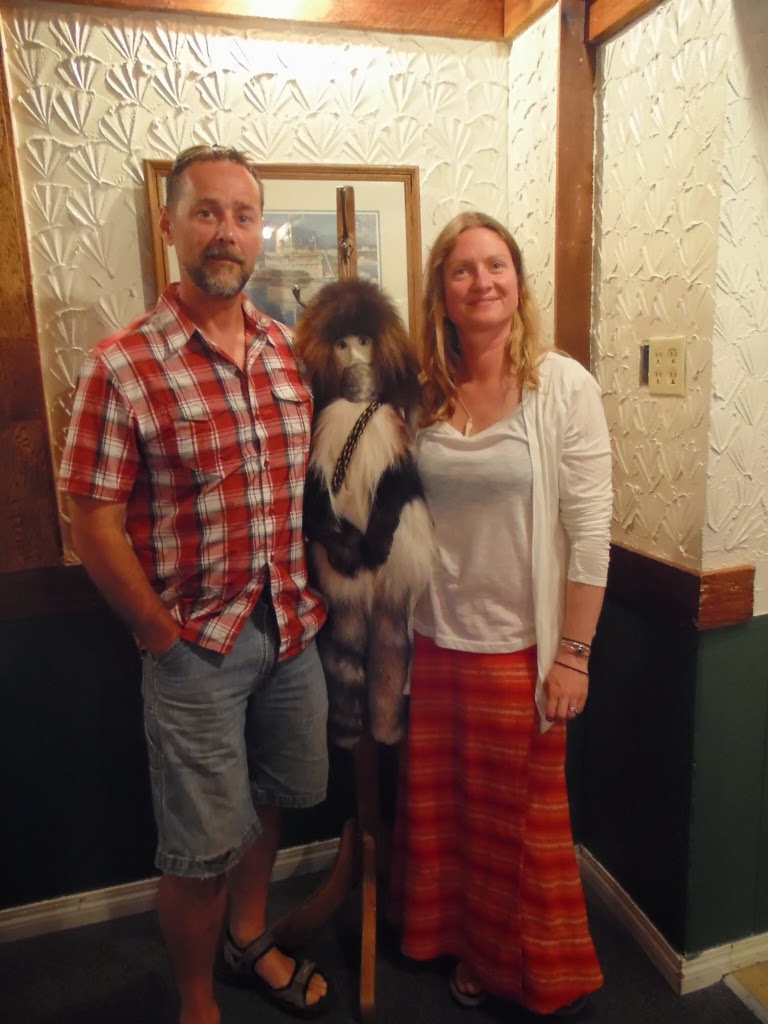
The picture above shows Parker and Belinda standing with the fur replica she made of him for an arts competition called Legends of the North, because, as she put it, "he's my legend, so, yeah."

Too right.

People have a tremendous opinion of Parker in Churchill, due in no small part to his staying out on the job for something like 36 hours during a full-on white-out December blizzard in order to keep power flowing to the town some years back. He downplays it, in a sense because he really did have no choice; he was the only hydro man in the area at the time. But people recognize and appreciate not only the dedication, but also the skill and humility.

To me, Parker's legendary status is derived from the manner in which he has acclimatized himself to living in a part of the world that most of us would dismiss as inhospitable for most of year, and to the fact that in a worst case scenario (say, a time travelling mishap), he could live in the bush with absolutely no technology pretty comfortably for quite some time, whereas I would be food for something else in a manner of hours, if not minutes. Still, getting to and from the bush in the dead of winter is not without its challenges, even for him. Thus, the snowmobile.

I know plenty of Albertans with snowmobiles, but these are largely recreational items; leisure craft, toys. Parker showed us the new snowmobile he purchased for this winter, and I was astonished at how many additions and modifications he needs to make in order for it to be useful in the bush.
National Park compliance sticker.
Hatchet, for clearing brush from the trail.
Extra big storage bins, in lieu of a trunk.
Heated hand covers, so you can wear reasonable sized gloves while driving.
Mud flap and a hitch, for hauling a sledge that might have 600 lbs of skins on it.
GPS, with both the trail waypoints and cabin programmed in, since a sudden whiteout could make even inertial navigation difficult!
Additional high intensity lights for better trail visibility.
An extended windscreen, which is pretty much standard issue for all the snowmobiles we saw in Churchill.
Just to give you a sense of the loads Parker can be dealing with, this is a picture of about half of all the martens he got in one season, plus some wolves for good measure. Imagine hauling all that out of the bush on foot! The other people are Jimmy, the fellow Parker bought the trapline from, and Jimmy's wife Betty.
Parker also showed us some of the kit he uses for drying and stretching skins, like this wolverine skin he recently finished up.

It's a fascinating window into a life I can barely comprehend, and can't imagine being less suited for. Still, even the glimpse is more than many Canadians will get, and I'm really grateful for a chance to look past the legends, and get a peek at the True North.

Saturday, September 14, 2013

Journey to the Edge: Extended Time

The MV Ithaca
Sometime after visiting the fort on Friday, we decided to accept Parker and Belinda's gracious invitation to stay on in Churchill for another three days; instead of returning to Thompson on Saturday with the others, we would leave on Tuesday's train instead.

I try to maintain a degree of suppleness on vacation, requiring a structure and schedule to ensure there is time to do everything you want, while also leaving room for spontaneous opportunities, but we'd never extended a stay like this.  There is usually some reason to be home on time, like work or school or an appointment of some kind, but this time there wasn't, so we cancelled our train tickets, bought new ones (still on sale!), and said goodbye to Mum, Tara, Jason and Jerry at the station that night.

The shindig at the cabin had turned into a runaway the night before, so a modest evening was mandated.  Splitting an elk burger with Glory at the Tundra Inn and enjoying the entertainment provided by a singer/guitarist and a contortionist (not at the same time) made for a relaxing, if somewhat surreal evening.

The next day was pretty laid back, beginning with a relaxing and delicious brunch at Parker and Belinda's house, after which Parker showed us the garage where he keeps some of his trapping and skinning gear, and where he is prepping his new snowmobile for the upcoming trapping season.  He also showed us some pictures from his remote cabin, which last spring's wildfires came uncomfortably close to.

We decided to do use the Ford Expedition we had access to to do a little exploring, and Belinda suggested we check out 'Brian's Castle', a large stone foundation which a local man is hoping to turn into a hotel.  We had driven past it, but were discouraged from exploring on foot by the bear warning signs.  Parker said there were next to no bears in that area this time of year, but gave me a jumbo can of bear spray in a nylon holster, just in case.

It is an impressive edifice, even at this early stage, and it's unfortunate that the momentum on the project has apparently been stalled.  Still, it would be a remarkable place to stay if it should ever get completed!  As it sits now, it was an excellent place for the girls to have a bit of a scramble.


The next day, I awoke to the sound of car horns honking.  It's just like being back home, I mused dozily, before a sharp realization:  Wait a minute, I thought; what the hell kind of traffic can there be in a town of 800 at six in the morning?  Sure enough, the horns were soon punctuated by the sounds of shotgun blasts, perhaps six or seven of them.  Incongruously, this actually made more sense than the horns by themselves, and so I went back to sleep.  Later on we discovered that a bear had decided to mosey into town by way of Kelsey Boulevard, the main drag, and the Conservation officers had turned out to scare him off.  Business as usual by Churchill standards.


We took advantage of the remainder of the day to do a little more sightseeing, including a trip up to Twin Lakes, which is about as far as you can get from Churchill by road.  Bear spray at the ready, we took the rutted old gravel road, and later a dirt trail, up to where a cabin stood by a pristine lake, and the girls took advantage of the opportunity to roll up their pant legs and at least get their feet wet.  Unlike the day we arrived, the temperature was in the mid-high twenties the last few days, and the cool water was a welcome respite.


The drive back took us past the Churchill Northern Studies Centre, which is the same site as the old Churchill Rocket Range, so I had to take a picture of the old launch site and blockhouse; after all, Captain Canuck had gone to space via this route when I was a kid.


The tide was beginning to come in as we made our way back to town, so we decided to take the off-road path to see the wreck of the MV Ithaca, an 80 foot cargo vessel that had been abandoned offshore by Bird Cove after running aground in 1960.  As we slowly made our way out to it, we spotted a white rock juxtaposed against the darker ones by the shore.


Sure enough, it was that morning's wake up call, peacefully snoozing on the rocks after finding the townsite's hospitality not particularly forthcoming.

This was the fourth polar bear we'd managed to see in Churchill, and even though it was some distance away, it was thrilling to be on the same level as this one, not separated by the thick walls of the fort or the elevation of the Tundra Buggy.  In many ways, this sleepy specimen was my favourite, simply because we had stumbled across it on our own.

Our last stop was The Weir and marina southwest of town, which we visited mostly because we could.


It is by no means necessary to have access to a vehicle in order to enjoy Churchill, but being able to range far and wide on our last full day in the area was a real privilege, and we took full advantage of it.

Hang on...how'd we manage to miss the floatplane base?  I guess we'll just have to go back...

Saturday, August 24, 2013

Journey to the Edge: Forts & Fortitude

Saturday was scheduled to be our last day in Churchill, so there had been an extremely festive gathering at Parker and Belinda's cabin the night before.  The following morning saw us a little worse for wear, but not so much that we would be forego our last activities: Tara was to go snorkeling with the belugas (!), and the 4 of us were going to head across the river with Parker and Belinda to see Prince of Wales Fort.

Parks Canada maintains a small dock and shelter, as well as some toilets about 200 yards south of the fort proper.  Most people arrange their tour with the Parks Canada staff at the train station back in Churchill, and get boated across accordingly.  With Parker having his own boat, we pulled up on the gravel beach, and our guide, Heather, told us we could settle up back in town, since they didn't have any receipts or change on this side.

Heather was one of two Parks staff who accompanied us on our tour, and was very knowledgeable about the fort, it's history and it's restoration.  The other was Brian, our designated bear monitor; since the fort is located on something called Polar Bear Point, this seemed like an excellent use of resources.

Brian had a utilitarian looking 12 gauge pump-action shotgun slung over his shoulder, which prompted me to inquire of Parker as to why this made more sense than, say, a semi-automatic rifle.  (Or perhaps a railgun.)  I don't have much practical experience with guns, but the limited range of a shotgun made it a curious choice to me, despite the stopping power I know it to have at close quarters.  Parker patiently explained to me that they are not loaded with buckshot, but with a solid slug, like an enormous bullet.  He said they carry something in the range of 500-700 foot-pounds of force against a target, which even a polar bear would find hard to shrug off.  That made sense, but honestly, the concept had validity to me as soon as you replaced a bunch of smaller projectiles with a single, 18mm bullet...


At any rate, we didn't expect to see any bears inside the fort, and that was what we had come to see.  Heather explained that the stone, star-shaped fort took over 40 years to build in the 18th century, and how it was used as a headquarters and trading post by the Hudson's Bay Company.

Once inside, you can see how a central courtyard had once contained two, two-story blockhouses.  The bottom story was made of stone, the top of wood and other local materials, but only the stone remains.  A Freemason's symbol remains engraved on one of the walls, a testimonial to the lasting power of stone.


Imagining life, here,so close to the bay, in the dead of winter, is difficult for us soft 21st century Canadians.  Small wonder that a man was hanged for stealing a goose intended for Christmas dinner.

Considering how remote this fort was back in the day, and how thick the walls, plus the added firepower of the Cape Merry Battery across the river, you could see how residing here might lead one to feel lonely, but relatively safe.  This turned out to be anything but true, and the Prince of Wales Fort was surrendered without a shot in 1782.

3 ships approached the fort that year, flying the Royal Jack, the same flag that waved above the fort, but Samuel Hearne, the governor, had joined the Royal Navy as a midshipman at the age of 12 (in fact, he may have been the inspiration for Coleridge's Rime of the Ancient Mariner), and recognized French warships when he saw them.  The two frigates were bad enough, but the largest vessel, the Sceptre, under command of the Comte La Pérouse, boasted more guns at 74 than the fort and battery combined.  Hearne exited the fort with a white flag and probably saved the lives of the 38 civilians under his command.

The French set to destroying the fort, and although the British and HBC returned the following year, it never returned to the same prominence, as the fur trade had already began to wane, the hunters and trappers having moved on to other posts.  He returned to England in 1787, writing his A Journey from Prince of Wales's Fort in Hudson's Bay to the Northern Ocean, which wouldn't be published until three years after his death in 1792, at age 47, my age as I write this.

What lessons does Fort Prince of Wales teach to us, a quarter-millennium later?  That Europeans hell bent on exploration can bring themselves to live just about anywhere on this planet? That even thick walls and good positioning are no match for determination and superior numbers?  That progress is almost always linked to commerce, and the company we now know best as an American-owned department store did the lion's share of the work?  That fate is fickle, and the rise of our nation is due to nothing quite so much as the fashion in 18th century men's hats is testimony to that?  It is tough to say.


While at the fort though, Audrey heard Brian's radio go off, asking if he had seen the bear by the beach.  She went to the west side of the fort and peered through the crenellations and sure enough, a now-familiar white shape was loping lazily along the shore perhaps 80-100 yards distant.  He disappeared behind a hill before I could snap a picture, but given how close we had gotten to two the day before, I hardly felt disappointed.  It did underscore the constant presence of these beasts, and the vigilance required to live here.

On our way back to the boat, Brian called out to Belinda.  "I hate to interrupt, but what's the special at the Tundra Inn tonight?"

Belinda smiled.  "Prime rib, sushi, live music, and a contortionist!"

The bear monitor's face lit up with a grin.  "I'm all over that!" 

UPDATED: I really miss these animated vignettes, so here is the one about the fort.


Tuesday, August 13, 2013

Journey to the Edge: Boats, Belugas, and Bylines

On Friday, Parker took 7 of us into the river on his outboard; Nan stayed behind because she is just not that much into boats, which is ironic for a Newfie.
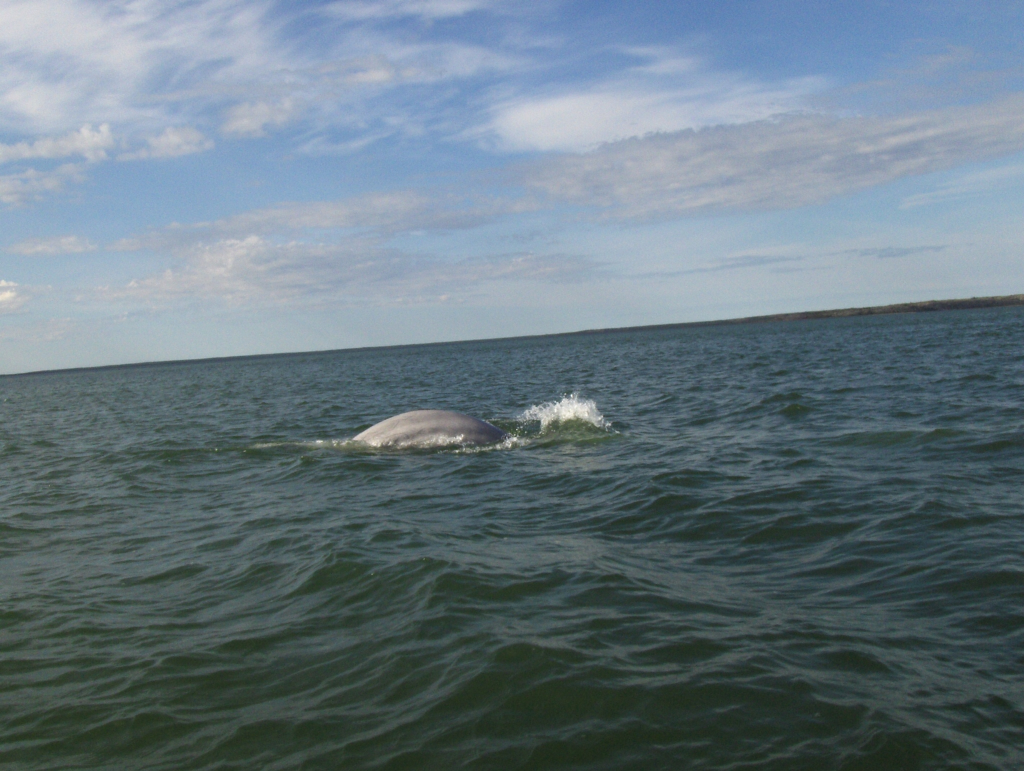
Parker wasn't able to get 'on step' with the craft as laden as it was, but we were still able to get a good look at the beluga whales which stream into the Churchill river over the summer as they raise their calves and take shelter from the killer whales of Hudson's Bay.
Like a lot of maritime creatures in the wild, belugas are brutally uncooperative photographic subjects, especially with a digital camera. You see the shadow of one approaching the surface, you ready your finger in anticipation, and then they ever dive back below, or briefly surface and then submerge just before the 'click' of a successful image capture. You are left with cryptic images of the water itself, interspersed with what could be either the backs of whales or simply the crests of waves. It doesn't much help that the young belugas are born a relatively dark grey, only lightening as they get older.

No, video appears to be the preferred medium for depicting belugas in their environment, and since the camcorder packed it in, we are left with a handful of shakycam footage shot with the ol' point n shoot.

Thankfully, our enjoyment of the experience was only indirectly related to our inability to document it, and everyone was thrilled to see the playful cetaceans in Parker and Belinda's backyard.

Parker also took us across the river to Sloop Cove, a small inlet on the west bank of the river where the men of the Hudson's Bay Company would dry dock their ships over the winter. They also left their names carved into the rocks so you can still see their names today, two-and-a-half centuries later.

Samuel Hearns was the first Governor for the HBC in the region, oversaw much of the construction of the Prince of Wales fort, and also surrendered it to the French in 1782, losing a fort but saving a lot of lives.

There are lots of other names, but the thing that strikes me the most is the care that went into the letters; the weighting of the lines, the attention paid to the serifs, the careful kerning. It's strange to think that even when it comes to graffiti, they don't make it like they used to.

It's both encouraging and daunting to know that there is a way to let your voice carry on a quarter-millennia later, if you have the stone, tools and patience.