Sunday, January 15, 2017

Seafall: Full Sail or Sea Fail?

Since having Risk Legacy recommended to me a couple of years ago, I have become a big fan of legacy gaming. Legacy games are built around the premise that, instead of starting afresh every game, some characteristics of previous games are carried over. (I suppose this sort of continuity is kind of like the difference between original Star Trek and Babylon 5, if you stop to think about it.)

In the case of Risk Legacy, every game sees some permanent change made to the board, in the form of a sticker denoting the presence of a bunker or ammo shortage which will forever affect that region, or the addition of cities and even the renaming of the continents themselves. After playing even a few times, your legacy board will be entirely unique.

Other forays into legacy gaming include Pandemic Legacy, but just last year a new entry arrived which is not built onto the chassis of an existing game, but designed as a persistent boardgaming campaign from the ground up: Rob Daviau's Seafall.


I read a review of Seafall on Ars Technica, and was intrigued by the premise, as well as the promised narrative. When I relayed it to my family, they were excited enough to agree to my proposal that we all pitch in and make it a family gift to ourselves. We've played three games thus far of the fifteen or so estimated to make the entirety of the campaign, and can finally write a little bit about the experience. Spoiler-free of course, which feels like a weird thing to type in a boardgame review...


Seafall is set on the western shore of a make believe continent with a roughly 17th century level of technology. Each player takes the role of a leader of one of the five provinces depicted there, each with its own sigil. Each province has a brief description of their past and culture, but neither the land nor the leader begin with a name; the player needs to supply both. You even select a portrait card depicting your leader, writing their name on it, and noting the space left for the addition of an eventual appellation like "The Wise" or "The Daring".

You don't get to choose your title though, as those are randomly handed out and help determine the turn order. They shift at the end of every game based on how well you did, too.

Each province begins the game with two ships, similarly unnamed, and their stats are shown on a provincial miniboard that also shows the lands you control. They also provide areas to put the advisors, treasures and gold you will accumulate over the course of the game.


Now, some Seafall players are going to want to get straight into the buying, selling, exploring and raiding that make up the game itself, but everyone is this household is quite fond of not just naming things, but for those names to have significance to them. So gameplay took a back seat while mobile devices came out and research into history and languages began.

Some players are going to being content to call their land "This Land", led by their leader Bob or some such, and that's fine, but be aware going in that some players are going to give the narrative just as much significance as the gameplay. In out case, there was no friction, but we all acknowledge that our games, particularly that first one, will take a little longer as a result.

For my part, having an icon that seems to depict a grey-coloured phoenix, and a history that included some sort of oppression at the hands of other provinces, I went with Pyravian as my province name, and named my ships the Blackbyrd and the Princess Lillandra in hopes of kicking off an X-Men theme. Istoria, Kennis and Roséus make up the other provinces.


The prologue game gives you a chance to learn the game mechanics without impacting the overall campaign too much, although you will end up naming the four nearby islands before you are done. The idea is that the provinces are only now returning to the sea and exploration after a long absence. Some of the islands have sites where goods may be bought (or plundered!), but most of them are unexplored.


Exploration is handled in an interesting fashion. Picking a site with a target number, you build a pool of custom dice, beginning with the number your flagship has as an Explore value, then adding more dice for any advisors you may have acquired (and who are also named by the players), a supporting ship, or any upgrades your ship may have. After rolling the dice, you count the number of successes you have, and if you meet the target number, you've succeeded. For any success you're short, your flagship takes some damage, and the third point of damage sinks it, sending it back to port to be relaunched later,

Successfully exploring a site leads to The Captain's Booke, a collection of numbered text entries. A map at the front helps you determine which entry to read, and then typically presents you with a choice in a 'choose your own adventure' format. For instance, perhaps the site produces wood, but the natives hold the grove as sacred. They implore you to leave it as is for now, but you can go against their wishes if you like. Your decision determines what entry you read next, and what the results are for you and your crew.
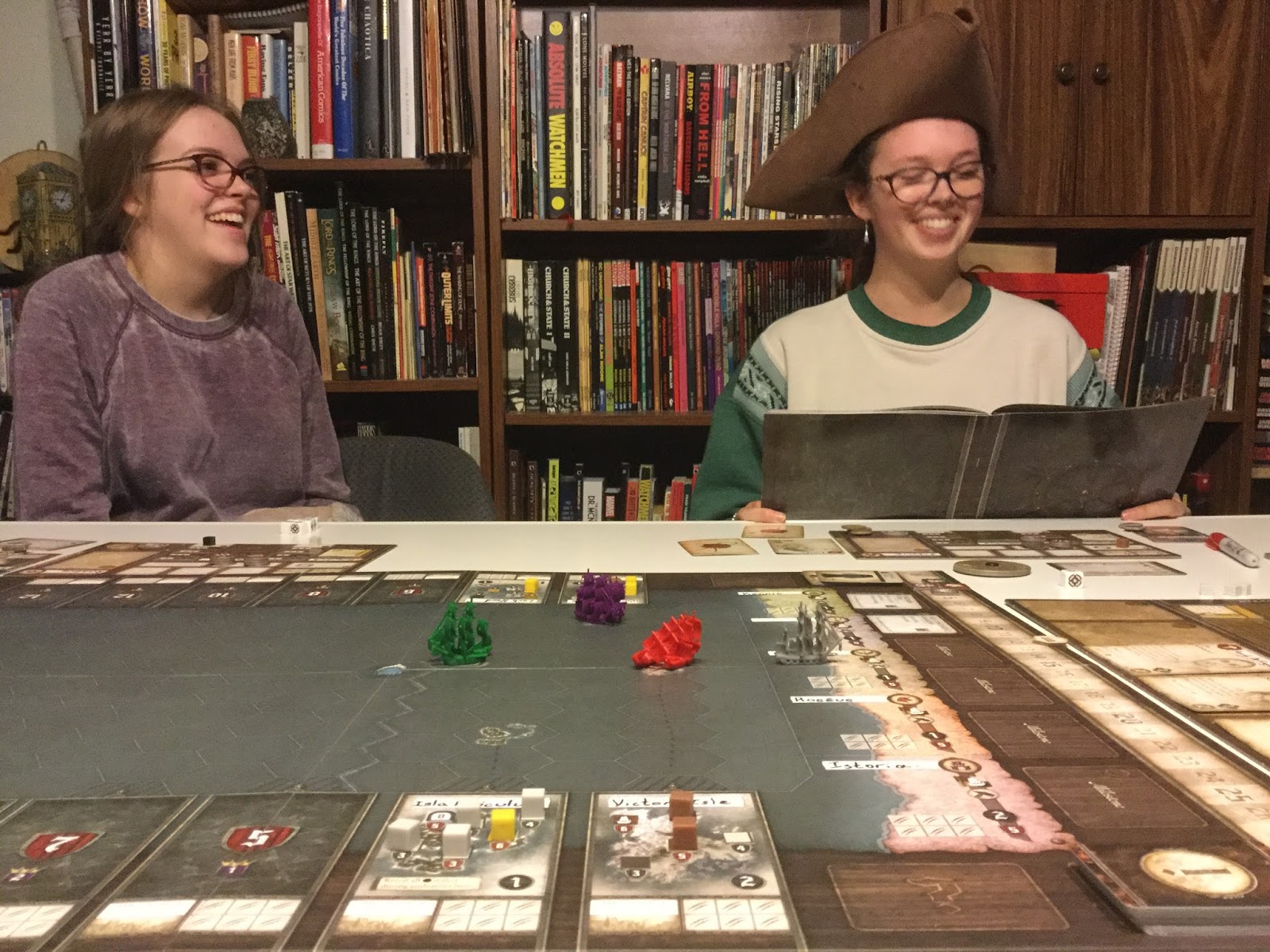


The game doesn't require it, but we have made wearing the captain's hat while reading The Captain's Booke mandatory.


One doesn't have to explore: you can sail about, buying goods and selling them, using the proceeds to buy treasures and gain Glory for yourself, which is how you win the game. However, since you also earn Glory every time you successfully explore an unknown site (or raid a known one to plunder its goods instead of buying them), the merchant path is not the fastest course to victory by any means.

There are also milestones provided, granted if you are the first player to raid a site with a defence value of 6, or be the first to have treasures worth 3+ Glory. These not only provide bonus Glory to help you win the game, but also give you the opportunity to gain other rewards like an appellation for your leader, which is why the leader of Pyravian is currently known as Prince Xavier deGries The Vengeful.

On rare occasions, milestones will also give a player the opportunity to open one of the 8 sealed treasure chests in the game, tiny boxes stuffed with cards, counters and rules which significantly expand the game!

In the prologue game, you are forbidden from attacking each other's provinces, and you won't be given the rules for attacking ships until a later games. You also cannot sail past the fourth island, but eventually a vast ocean will yours to explore, discovering new islands and unravelling a mysterious story only hinted at in the excerpts from The Captain's Booke.

At the end of the game, every player has the chance to upgrade one of their ships and select an advisor to being the game with next time around. The winner can select from a number of bonuses in addition to this.

Three games in, we've been having a great time, exploring, naming, and trading, so this felt like a good time to talk about the pros and cons of Seafall, starting with the cons.

The biggest shortcoming of the game is that when it is not your turn, there is nothing for you to do. Even if your province is attacked, your participation is minimal. It pays to watch the board so you can plan your voyages and have an idea what goods will be on a given island when it is your turn, but impatient types may find the delay between turns interminable.

Games like Risk 2210 have acclimatized many boardgamers to having surprises in store for would-be attackers, so strategists will lament the lack of options for defending against the depredations of other players. As a result, I recommend being the first player to do so if you can, although this is why Baroness Lillian of Roséus now feels tremendous animosity toward Xavier the Vengeful, although Glory herself assures me we are still cool.

Honestly, that's about it for shortcomings, for my part. In terms of elements I appreciate outside of the excellent legacy aspects, foremost would have to be the way they handle aggression by use of something called Enmity tokens.

If you attack a site on the board, you place one of your 8 Enmity tokens on that site, signifying that no other players can raid it until after the next winter, which comes every 6 rounds. After that, the token moves off that site, but remains on the island, and not only makes them more resistant to future raids, but increases the cost of any and all goods purchased from there.

Attacking other players means you have to give them an Enmity token as well, which not only limits the number of times you can attack anyone in a game, but they can also use Enmity tokens to gain a bonus when they attack you later on that game!

During the wrap up, you may have a chance to roll some dice for the opportunity to take back some Enmity, but if you don't, you will add a permanent Enmity sticker to that province or island for all future games!

All in all, Seafall feels a bit more random and bit less strategic than you would expect from a hex-based game with such efforts at balancing included in it, and the final assessment as to whether or not this game is for you rests on a number of non-qualitative factors.

Seafall is probably NOT for you if:
  • Winning matters more to you than playing
  • You are an analytical player who needs a rationale for every loss
  • You have too short an attention span (YMMV)
  • You dislike surprises or unexpected turns of events
  • You need to know all the rules before you start playing
  • It is difficult to get the entire group together regularly
Seafall may well be your cup of tea if:
  • You like naming ships, islands, advisors, et al
  • You appreciate a game with a built in narrative
  • Having your exploring decisions sometimes turn out counter-intuitively is not upsetting
  • Your co-players are all swell folks curious to see how things turn out
  • 2+ hrs of gameplay is not a daunting prospect
In the end, Seafall is unlike any other gaming experience I've ever had; a heady combination of strategy, trading, exploring, and even a bit of role-play. While the game's ruleset is by no means perfect, it is a fascinating and entertaining step along the way in the evolution of legacy gaming.

Monday, January 9, 2017

Merry Gracemas

This was an especially hectic Christmas season.

It came on the heels of a particularly busy time at work, with me staying until 8:00 or later pretty much one night a week for the past couple months in an effort to keep our project on schedule. In previous years, things slowed down int he office as the end of the year approached, but in 2016, we were hard at it right up until Friday the 23rd.

Then it was off to Rocky Mountain House for a chance to visit with Audrey's sister and her family. Then back the next day for the Christmas Eve service at church, in which Audrey was singing with the choir and I was responsible for arranging the communion elements.

The next morning it was off to Leduc, to spend Christmas Day with my sister and her family, and, for only the second time in over ten years, my Mum!

We overnighted there and then returned home on Boxing Day, having the 27th to ourselves before packing up again and heading down to High River. Audrey's Mum had turned 80, and her brother had set up a big party that ended up becoming a combination open house and family reunion.

After that, we headed back to Edmonton, but brought Audrey's other sister from Ontario with us for a visit. It was wonderful to have her, especially for the two nieces she always wants to see more of, and she headed back today.

So, yes, a bit of an Xmas whirlwind, complicated by the fact that I started out virtually exhausted, and didn't just become that way over time. As a result, none of us are particularly keen on returning to our normal routines at work and school.

I had been extremely apprehensive in the days leading up to Christmas, but an offhand comment at the grocery store on the 22nd helped me to keep things in perspective.

When I picked up the bread for communion that Thursday night on my way home from work, I discovered that we were short on the juice we use in place of wine. My own fault, really, and I have subsequently begun labeling the bottles "COMMUNION". (Should that fail to have the desired effect, I believe I still have some biohazard decals lurking about.) Still, it meant yet another stop on my way home after a tiresome day, at busy supermarket full of increasingly frantic shoppers finishing their holiday preparations.

I couldn't even find the juice I wanted, and grabbed what I hoped would be an acceptable substitute, then headed to the cashier with the shortest lineup. As the cashier rang up my purchase, she asked me if I was finished my own preparations for Christmas.

"I suppose so," I said. "We're frightfully busy this year, travelling to three different towns in six days over Christmas, but on the plus side, we don't have to host this year." In truth, this was the first time that aspect had occurred to me, and it felt encouraging.

My clerk nodded in agreement and completed our transaction. She handed me my receipt, saying cheerily, "That's good, you deserve to be pampered."

I thanked her and began walking out to the parking lot, considering her words as I trudged towards the Flex. I was a bit consternated, in truth. How the hell does a stranger know what I deserve? I thought bitterly. I certainly hope I didn't earn this hectic Christmas schedule for something I did or didn't do! 

I opened the door and swung the grocery bags into the back seat. What does deserve have to do with anything anyways? How can you tell someone what they deserve when you know nothing about their situation? I started the engine and threw the Flex into gear; I could feel myself getting upset, which was ridiculous.

Calm down, I told myself. You're right, she doesn't know you; that's the kind of comment she probably says to dozens of people a day. Who's to say who actually deserves it...

...unless everyone does.

The thought leapt unbidden to my mind and settled there, like the raven on the bust of Pallas in Poe's poem.

Maybe it's true because everyone deserves to be pampered every once in a while, whether or not they've been a polite gentleman or a surly bastard, or maybe even sometimes because of it.

Maybe every single individual not only deserves it from time to time, but needs to be reminded of that fact, as I had just been.

It was an astonishing and seasonally appropriate reminder of the power of grace; this notion that good things can come into our life even though we mightn't feel we earned them.

Whether you attribute their origins to the divine, or kismet, or simply blind chance, I think it still behooves us to remember them with a sense of gratitude, and most importantly of all, to pass them on wherever we can.

Reflecting on it in that snowy parking lot, that simple statement from an anonymous cashier in a busy grocery store did as much to ensure I had a Merry Christmas as any other single event or thing. I would hate to forget it, so I am committing it to writing here.

To remind me to always be aware of grace in my life, and to be grateful.


Sunday, December 25, 2016

Advent Beer 24: December Flower

The final beer! Revealed only this afternoon after a trip to Rocky Mountain House which included a side-trek to the only mechanic open on Christmas Eve, and only to have the same sputtering symptoms recur on the return leg of the journey! Partaken of too late at night, in the strange time betwixt the end of the church service and the stuffing of stockings by parties unknown! Written about 2/3 of the way through the glass as the sweet nectar quenches a deep thirst both physically and spiritually (it's been a mad season, let's talk about it over a beer some time...).


It is a high test Belgian called December Flower from the White Pony brewery, and is approaching barleywine territory at 11.8%.

It pours a clear copper colour with almost no head to speak of, and aromas of yeast, spice and crisp fruit, perhaps apples or pears.


December Flower is a fragrant and spicy mouthful, well suited as a winter warmer. It is heavily hopped as a balance against both the malts and the alcohol sweetness, and succeeds handily, in my estimation.


Another beer ill paired with foods, but a delightful fireside beer, perhaps shared with a friend over a strong cheese like Cambozola or a sharp aged cheddar.

This year's Advent calendar has had an extraordinary assortment of beers that have been both tasty and intriguing; a delight to discover and a joy to imbibe. Another great job by Calgary's Craft Beer Import!

Saturday, December 24, 2016

Advent Beer 23: Clootie Dumpling

Yesterday's advent beer was sampled in sub-optimal conditions; eaten with supper between arriving home from work and departing into a winter storm on our way to Rocky Mountain House.


Here's what I can tell you about the beer: it comes from a brewery in the Orkney Islands off Scotland, and Clootie Dumpling refers to a type of dessert pudding native to those parts made with breadcrumbs and dried fruit. "Cloot" is actually a reference to cloth, as per the admonition to not remove layers of warm clothing until after May, or, as they might say in the Orkneys, "ne'er cast a cloot til Mey's oot". Boy, you can't argue with that, can you?


It pours a festive amber with a bit of head but nothing too expansive or long lasting. Scents of light malts, and sweet fruits come through in the aromas.


On the palate, there are hints of ginger and cinnamon and other spices. Clootie Dumpling is sweet, but not like a dessert beer of high alcohol number. In fact, at 4.3%, it is astonishing to me that they would market this beer as a winter warmer, but it is well balanced, tasty and fresh, and a delicious accompaniment to pizza wolfed down before hitting the open road.

Thursday, December 22, 2016

2016 Advent Beer 22: Sauerkirsche Stout

Evil Twin Brewing is a gypsy brewer headquartered in Denmark. Having no brewery facilities of his own, he creates his ales at other breweries on a contract basis. This sort of thing originated in Scandinavia, and is the reason that today I will be drinking a Russian-style Imperial Stout brewed with cherries, which has a German name, but is actually brewed in Spain, by a Dane. Got all that? Good, that may be on the final. On to the beer!


It decants a dark, oily, reddish-brown, almost black, and with virtually no head to speak of. I worry for a moment that the beer has gone flat, but mild carbonation is detectable upon sipping. The beer smells of high alcohol sweetness, rich coffee and the scent of cherries.


Sauerkirsche Stout comes across strong and bitter at first, leading with the toasted malt, but this is quickly swept away by the sweetness of the 10% abv and the aftertaste of sour cherries. The beer does not taste like candy, nor like a Hostess fruit pie, nor like Robitussin...well, maybe a little, but honestly, I think that's more due to the abv than the cherries. I would have liked a bit more carbonation, as the finish feels a little oily and could use some freshening. Still relatively delightful though.


A deep dark drink for a deep dark night; well suited for the second-longest night in what has felt like a particularly dark year at times. At this point, I can't imagine pairing this beer with anything except a proper Bavarian Black Forest Cake, as it is practically a dessert in its own right.

Wednesday, December 21, 2016

2016 Advent Beer 21: La Débauche Cognac Barrel

My very first thought was that if the beer was half as complex and entertaining as the label, I would be sitting pretty by the bottom of the glass,


The beer is from France's Brasserie Débauche, and is a barleywine aged in cognac barrels. Drawn by a comic artist named Grimal I am sadly unfamiliar with, the label is reminiscent of the infamous tarot card The Tower, 16th of the major arcana, and symbolic of change and upheaval.

Well, change is all well and good, but no one likes to talk about upheaval whilst drinking a 10% abv barleywine, so maybe it is best to forego the symbology at the onset and get into the beer.


My label ponderage did give the beer a little time to warm up towards the recommended 10 degrees celsius, but pouring it did unleash a particularly vigorous head of dense but fluffy sepia-tinged foam. The head actually insulates the beer tremendously well and makes discerning aromas fiendishly difficult, but bready malts and yeasts followed by sweetness are still detectable. Later on the beer takes on an almost winey character in terms of the nose, which seems wholly appropriate.

On the tongue, the strong alcohol and cognac elements assert themselves with a spicy, acrid tang. The sweetness comes through in the finish for me though, making the experience very pleasant overall. Bread and brandy mingle on the palate throughout each mouthful, leaving a tingly sensation afterwards.


La Débauche Cognac Barrel is almost as complex and intriguing as its label, which is high praise, and this beer is an excellent winter warmer and an excellent capstone to an even of warm fellowship on a frosty night. It could also be an excellent complement to certain dessert courses; not many barleywines could conceivably wash down a crème brûlée, but this one might make a go of it.


Tuesday, December 20, 2016

2016 Advent Beer 20: Oud Bruin Hip Hops

There is a lot to be gained, and nearly as much to be lost, from reading the label of a new type of beer. Reading it, you diminish the chance of surprise and risk colouring your own descriptions with aspects written into the bottle copy. Skip it, and you approach the beer wholly unprepared, a virtual blank slate.


Reading the front of the label told me a few things: that the beer was 6% abv, from Belgium, and based on the name, would be hoppier than the last few beers to emerge from this year's calendar. Oud Bruin seemed likely to translate into 'Old Brown' an apt description perhaps of an aged brown ale,

Well, sort of.


I poured the beer, marveling at its reddish coppery colour and robust, off-white head, the colour of parchment. A tangy, yeasty smell emanated from the glass, along with a crisp, fruity flavour I couldn't pin down. Citrus? Maybe. More appley though. (Appleish? Applesque?) It's a scent I've come to associate with several Belgian ales I have had over the years, and took an anticipative sip.

Surprise!

Very, very sour. Not pickle-juice sour, but heading in that direction. My entire palate convulsed at the intensity of the taste, but then noticed the fruit characteristics (sour apple, maybe some grapefruit in there) and some floral notes in the finish. It's medium bodied, but oaky tannins add even more nuance to the drink. Once the shock wore off, a complex and entertaining mouthful, to be sure.


Some very quick research reveals that 'Oud Bruin' is not a brown ale of the British variety, but an established type also known as the Flanders Brown, from the Flemish region of Belgium. It is twice fermented and bottle aged, and this Hip Hops variety is actually barrel aged in between. The sourness is a result of the yeast and bacteria associated with bottle-fermented beer, and is a desired characteristic of the style.


Even the label suggests this, had I bothered to read it: "wakes up your mouth with a big punch in the face." Well fair enough, does what it says on the tin, I suppose. I love sour things as a matter of course, but most sour beers have left me cold. Oud Bruin Hip Hops is a fascinating and challenging beer I am glad to have tried, and would explore again, given the chance.


The inherent tartness makes it a bit of a challenge in terms of pairing, but I think fish or seafood seasoned with lemon, or possibly a Greek salad or something else feta-based might complement it well. A bowl of spicy chips of some fashion might not go far astray either.