As some of you have observed, I am no longer continuing my long-running daily blog for the Craft Beer Advent Calendar. I can't say whether it is the result of complacency, familiarity or a simple lack of human capacity, but last year's entries became a bit of a chore, I'm saddened to say, and I resolved on the 24th that I wouldn't follow through this year.
Besides, now that I am tracking my beers on Untappd, it feels a bit superfluous to do so again here, in a format that demands I struggle to come up with new synonyms for "effervescent", "resinous", or "pungent."
Still, there have a been a couple of notable entries in this year's calendar, and some of the labels have been quite striking, so I will be doing a summary of this year's offerings in four parts - a series of "six-packs", if you will (or even if you won't).
This is the first time I can recall the advent beer calendar having a discernible pattern, but thus far each brewery has had two selections proferred on successive days. In the first six days I've had the good fortune to try beers from England, Mexico, and the Yukon Territories.
Day 1: FUBAR
Tiny Rebel Brewing in Wales kicks it off with a session Pale Ale. Hoppy beers will never be my favourite, but this was a nice one, crisp and light.
Day 2: Orange Mocha Frapp Stout
The latter half of the Tiny Rebel dyad, and worth the wait. This milk stout is thick, rich and creamy, without being cloyingly sweet. At 7% ABV it is either a poor or brilliant choice for a breakfast beer.
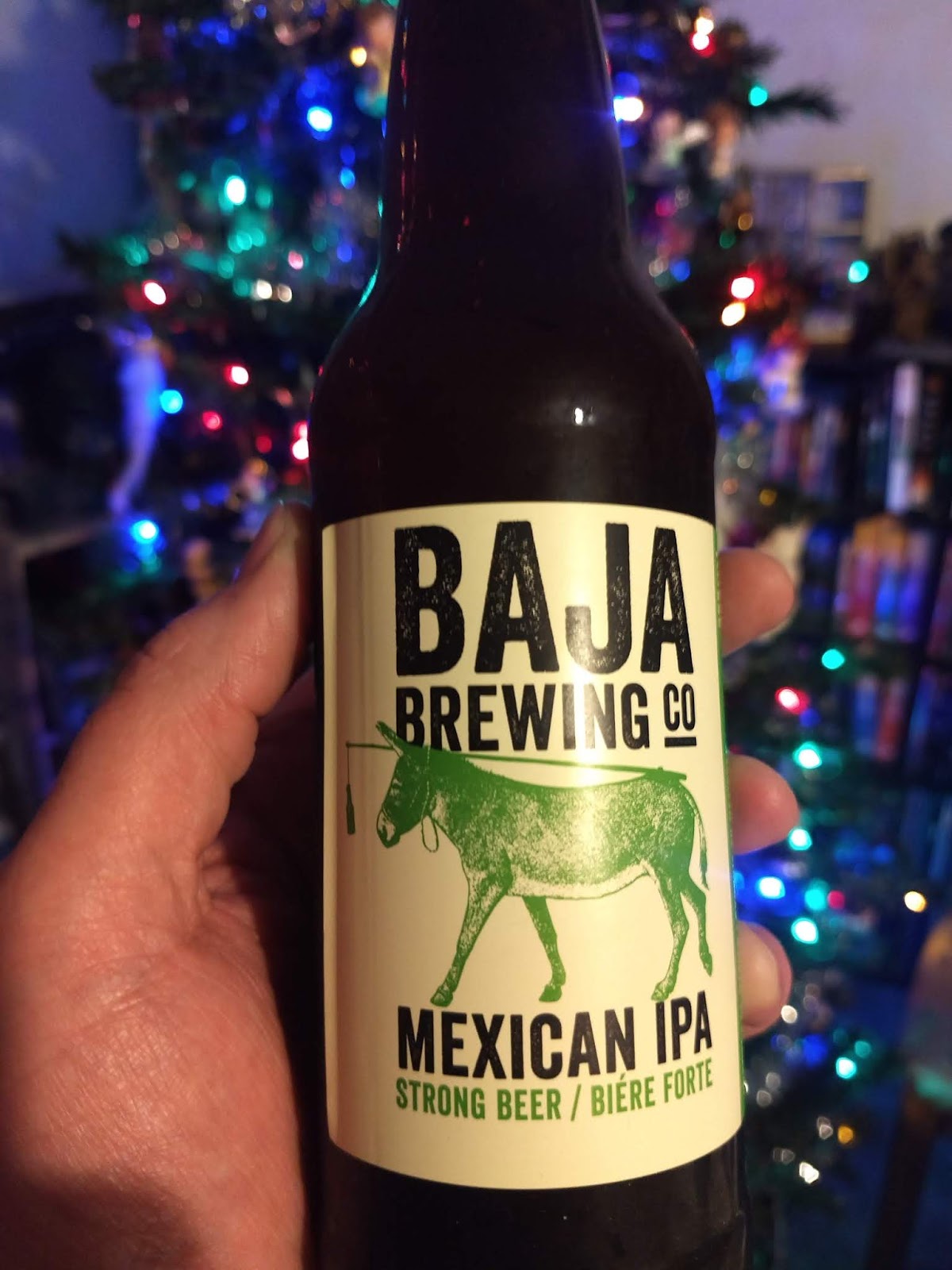
Day 3: Mexican IPA
The best label thus far, courtesy of Mexico's Baja Brewing, this is another well-balanced India Pale Ale that is both strong and refreshing.
Day 4: Ay Ay Ay PA
From the best label to the best name, this 4.5% session IPA was not really my style sadly. But maybe it's because I only had one of them? More research may be required.
Day 5: Imperial Stout
From Yukon Brewing in Whitehorse, our first heavyweight at 9.5%. One of my favourite styles, and this one was fine. Higher marks may be from people who can actually taste all ten different malts, but I was just glad to have them all there. Disappointingly named though, I have to say.
Day 6: Tamarack and Spruce Tip IPA
The other Yukon beer is far more creative and distinct. Not overpoweringly piney, thankfully, but still enough woodsy, resiny aromatics to be a hophead's delight.
I suppose the onset of midwinter has always been a bit disorienting.
For the earliest humans, the absence of vegetation and shortening of days probably felt like the end of the world. Meanwhile, their far more secure descendants scurry to and fro amidst a maelstrom of competing plans, frantically trying to get everything where they need it to be before an arbitrary calendrical eschaton.
Our Christmas commitments have lightened in some ways and become complicated, but not enough to completely distract us from the beauty of the season. Case in point: last Sunday we had two separate cultural engagements, which both turned out to be a delight.
In the morning, Fenya and Austin agreed to sing during our advent service. For a couple with choral music on one side and modern rock sensibilities on the other, they did a fine job together.
It was also very well received, and it took Glory and I quite a while to get out of our aisle while congregants hemmed the performers in, proferring thanks and praise while slipping in requests for future performances.
But we had to expedite our departure, because Glory was due to perform at the Festival of Trees that very afternoon. The dancing was fine but I was actually proudest of Glory for something else.
During their team dance, one of the girls began feeling unwell. Glory asked if she was all right, and her teammate clearly wanted to continue. A moment later though, her knees buckled, and Glory, standing beside her, quickly took her arm and led her offstage almost immediately, the other dancers following closely behind.
It didn't feel immediate to her at the time; in Glory's mind she reeled, wondering if cutting the dance short was the right thing to do, before finally deciding it was. When I showed her the video, she was astonished at how little time actually elapsed between the collapse and her leading the team offstage.
The other dancer is feeling much better now, but wasn't able to make it onstage for the finale. Luckily I had just enough battery life in the camera to catch the performance in its entirety, albeit from a bad angle.
The crowds at the Festival of Trees can be bit much for me, but the array of decorations coupled with lively performances make it a visual treat, for a while at least. It made for a long day in some ways, but having so many opportunities to take pride in my girls made that easy to bear.
The most recent manifestation of my boardgame Kickstarter addiction is heavy with half-remembered nostalgia - a lovingly remastered version of Fireball Island from 1986.
Restoration Games, a company that includes my favourite games designer, Rob Daviau, is not only dusting off forgotten treasures like this, but taking the opportunity to improve them as well.
Both the original and new version of the game has players moving their pawns around a contoured map, with the ever-present threat of a marble knocking you over. This is, of course, the gimmick that drew me to the game in the first place.
Look, games with a kinetic element are just that much cooler than games without them. I have spent a lot of enjoyable hours playing D&D and tabletop wargames, but had almost as much fun in a single night playing Weapons & Warriors a quarter-century ago with Jeff. He'd brought a Castle Combat set from the toy store he was working at as part of their product familiarization program, and although two grown-ass men had no business playing we had a whale of a time using the tiny catapults to fling plastic boulders at each other's fortifications. Outside of spinners and dice, very few of the games I play now have moving parts, and ever since Mousetrap, that's been a big draw for me.
(As was Mousetrap itself, which I never played as a child, since every time I spied a box on someone else's shelf and pointed it out, it was unplayable due to missing pieces, without exception,. Honestly, why keep it then?!)
Anyhow,Restoration games made a number of significant improvements to the original, from the components to the gameplay.
A much larger, vacu-formed, three part playing board, with full colour throughout.
Trees with pointable 'roots' which can be used to redirect the embers and fireballs.
Card-based movement instead of dice-based (who hasn't wanted to quit a game after three consecutive rolls of 1 or 2 on a single die?).
Multiple paths to success instead of a single goal.
A 'ticking clock' mechanic to keep things moving briskly.
Instead of portraying adventurers racing for a single treasure, the players are now all tourists on a remarkably dangerous island, using their turns to gather treasures scatted about (including the fabled gemstone, the Heart of Vul-Kar) as well as a limited number of snapshots at specific points on the island.
Periodically players have the opportunity to launch one of two different types of marbles: ember marbles, perched precariously at points along the paths, represents lava bursts, flame geysers and the like. Fireball marbles are the result of Cataclysm cards which causing a fireball marble (1 initially, 2, 3, and even 4 later on) to be launched from Vul-Kar, the volcanic idol at the highest point on the board. There are three different apertures from Vul-Kar, so it is almost impossible to anticipate precisely where the fireballs will go.
Knocking pawn over forces that player to surrender one of their treasures to you (or to a pool called The Maw if you do it to yourself), but then they (or you) draw a Souvenir card for their troubles. I mean, honestly, I would probably knock over the pawns of other players simply because I could, but incentivizing it with treasure is a grand idea. They also resume play from their new position, which can play hob with their plans, especially at the end of the game.
Souvenirs let players do a number of things, from navigating the island's caves, to soaring along with a jet pack, but timing their usage can be critical. Souvenirs from one of the expansion packs (the "hangry" souvenirs) are "a-ha!" cards played to provide comeuppance to the other players.
The final countdown begins after the 4th fireball marble gets added to the Cataclysm pool, or when a player returns to the helipad with all three types of snapshot. First into the "hello-copter", a 3d punchboard prop, gets the "lucky penny" token, an unstealable treasure worth almost as much as the Heart of Vul-Kar. Once the hello-copter is summoned, players have only two turns to make their way to the helipad, or else their snapshots aren't worth any points at all, which makes it an inopportune time to be pushed into a river or down a path.
The game has a limited amount of strategy, but it's more than none, and the card-based movement keeps the game from being excessively random. On the other hand, the marbles are about as chaotic an element as you can have in such an activity. They keep everyone on their toes and provide tremendous amounts of drama and vicarious entertainment, especially if you are safely ensconced in the hello-copter.
It's a great-looking game, to be sure: colourful, three-dimensional, dynamic, and fun, - maybe one of the most impressive non-miniature games I own. The printing on the island, though inconsistent from set to set, is clear and largely easy to follow, and the components look great, especially the painted pawns I ponied up for, and the deluxe marbles they threw in as a stretch goal. But all those aesthetics are for naught if the game is no fun, right? Well, no worries on that front.
We played the game twice over the weekend, and had tremendous fun each time. My Kickstarter package came with all the expansions, but I am trying to leaven them somewhat gingerly, as I a) want to understand the base game before adding too much into it, b) want to build anticipation for them, but most importantly c) I don't want to overcomplicate a game whose mechanics are so elegant and simple out of the gate.
"Disappointed!"
Having said that, I look forward to the addition of an Indiana Jones-type explorer along with smaller marble snakes, a gold idol and extra-large foam boulder in "The Last Adventurer", as well as a tiddly-wink-style tiger you launch at other players from the tabletop and a hive full of marble bees in the aptly named "Crouching Tiger, Hidden Bees". Only after we have a few games with those under our belts will be break open "The Wreck of the Crimson Cutlass", a pirate ship just offshore of Fireball Island. They are also working on an app with scoring and sound effect functions, as well as a co-op mode and a D&D adventure.
The game's 5-player limit means it is a poor fit for G&G, but I may bring it along as a sidebar game anyhow due to its novelty and its nostalgia. In the meantime, Restoration Games is working on another 80s boardgame with a novelty element: Dark Tower! But I'll let someone else Kickstart that one; I'm taking a break for a while.
We are facing some struggles with bringing our church into the 21st century, and for once, the issues are physical and not theological!
The pulpit, i.e. the bunkerized lectern sort of affair where ministers once preached from, was removed last year to open up a bit more of the chancel, the raised area at the front of the church. We accomplished the removal ourselves, and brought the former pulpit to the rear of the church where it now serves as our sound booth. Waste not, want not, right? There were a few ugly strips of missing veneer when we were done, but a gifted congregant with a background in stage and television production was able to match it up almost seamlessly.The pulpit's removal did leave nearly a four-foot drop however, which needed to be addressed.
After looking at a number of options, we contracted a company to install a short wall of tempered glass which would prevent falls without blocking line of sight to those onstage. We paid a deposit to the contractors, found our own posts to hold up the glass, and the whole thing promised to be both safe and aesthetically pleasing.
Then the contractors went out of business unexpectedly (at least to us) and there is very little prospect of getting our money back, so it was kind of back to the ol' drawing board, there.
Then our first choice for a replacement contractor informed us that the first one's plan would not have been up to code, and that the posts would need to be bolted all the way through the concrete substrate (I believe? I don't actually speaking construction...). This would take the estimated cost from the approved $6.500 to about $10,000. Yikes!
Well, we certainly couldn't leave the chancel as it was, so we bit the bullet and that committee prepared to ask the congregation at our semi-annual general meeting for additional money to finish the task, almost a year after we had begun.
Just prior to this meeting, one of the committees I sit on heard tell that an alternative might end up being presented at the Semi AGM. Now, I don't know about your experiences at large meetings, but in my estimation, they are a great place to have ideas debated on a yes/no sort of basis, but a terrible forum for the consideration of alternatives. Asking a couple hundred people "forward or not?" can be a productive discussion, but an inquiry as to "which way should we go?" will always be inclined towards quagmire as people alternate between boosting one alternatives, denigrating another and then adding another to the mix for good measure.
To make matters worse, the option was rumoured to be a row of planters bolted to the stage floor and then supplanted with some manner of shrubbery to present a visible barrier as opposed to a more physical one. Despite being in a place of worship, we had very little faith in this plan.
Long story short, instead of presenting two alternatives, we were presented with an opportunity to approve the additional funds if needed, but were given to understand that the parties involved would have two weeks to present their alternative to all of the impacted committees and then, pending their approval, council would be given the choice of the two alternatives.
My committee was shown the alternative on Thursday night, and it didn't involve planters, although that idea had indeed been floated at one point. Instead, the problem had been turned on its head: what if, instead of preventing the fall, we reduced the height of it, by effectively bringing the floor closer?
By adding three 12-inch steps below the stage, the height of the fall was reduced to a mere 18" - the same height as the stage in our upper hall, and well within code standards.
It's fascinating to me to see people thinking "outside the box" like this. The classic example is usually Alexander the Great cutting the Gordian Knot instead of untying it, but I always think of influential Soviet filmmaker Sergei Eisenstein, director of The Battleship Potemkin and Aleksander Nevsky.
The way it was explained to me, early cinema was almost frustratingly literal, For instance, in order to show one person shooting another, they both had to be in the frame at the same time. This not only rendered them smaller onscreen and removing a lot of nuance from the act, but also made it almost impossible to convey emotion for the characters involved.
Eisenstein was the first to trust his audience to follow a visual narrative; by showing a closeup of someone shooting a gun followed immediately by a cut to the reaction of the person being shot, people immediately put the two together, "Hey, that first fellow just shot that other one!" This technique, known as montage, opened up a lot of doors for visual storytellers. He essentially added "editing" to the filmmaker's toolbox.
It's such a simple solution that you marvel that no one had come up with it earlier, but someone always has to be first. Someone needs to apply that differing perspective that can sometimes present an elegant solution to whatever problem you're facing. Thank goodness these people exist!
Furthermore, there is no telling from whence these individuals and their iconoclastic ideas might come; the individual who came up with the steps solution to our railing issue is the same one who had initially suggested the wall of planters.
Look, I'm not going to apologize for liking Muse's previous album Drones, okay? In the context of a band that is clearly addicted to change, moving from The 2nd Law to a more stripped down, blues-rock-driven album makes a certain degree of sense to me, and will always be one of those albums that sounds better the louder it's played.
But in retrospect, it is true that something is missing from their most thematic effort: fun. Perhaps that's not surprising for an album based on the dehumanization of modern warfare, but its seriousness makes Drones stand out in a discography built as much on playfulness as experimentation.
Muses's latest album, Simulation Theory, isn't necessarily a return to form, only insofar as the trio's mercurian nature seems to prevent them from having such a thing. You can safely say that the return of synthesizers and other electronic instrumentation feels a bit more in line with a 'typical' Muse album, but this time around the principal tool is actually a blender.
Simulation Theory blends a lot of things, principally musical eras. From the album's cover (by Stranger Things artist Kyle Lambert!) and many of the videos they released prior to the album, you won't be surprised to find a lot of the 80's up in here, but there are elements of '90s power pop, '70s guitar riffs and road-trip rhythms, and even record scratching reminiscent of the nascent days of hip-hop.
Genres are blended too, with lead off track Algorithm opening with a cinematic, synthesized bassline that The Guardian described as "none more jackbooted" and bears its nerdy, sci-fi roots proudly in the synthesizer leads before briefly turning things over to the graceful tinkling of a proper piano.
Thematically, much of the album deals with idea of our existence being a computer-driven artificial reality, but it isn't applied particularly coherently across the album. Since ST was produced one single at a time with a variety of producers, the simulation angle gives Matt Bellamy and company the ability to indulge themselves in whatever way they fancy, and to explore the idea of fantasy becoming reality.
For my part, I think Simulation Theory is Muse's most enjoyable album since The Resistance. Despite the sometimes jarring juxtaposition of styles and tempos, I've yet to find any skippable tracks, and the anthemic choruses of many of the songs make them a great fit for the band's high energy arena shows. (With any luck, I will go see them in Houston this February, so I will let you know how that works out.)
Most importantly though, the fun is back. Pressure is the catchiest Muse track since Knights of Cydonia, and incorporates some of the horns that made Panic Station so infectious, as well as some the fuzziest guitar I've heard from Bellamy yet. And the video featuring Terry Crews is straight-up brilliantly cheesy.
(What's that? Oh, you like horns? then check out this version by the UCLA Bruins Marching Band who backed the band on the deluxe edition of the album!)
Muse plans to release a video for every track on the album, actually, which I suppose makes suckers like me who buy physical media kind of suckers, huh? But hey, you can try it before you buy it, and here are some of my impressions for no additional charge.
Road Trippiest Track: Something Human
A melancholy yet hopeful paean about finishing a long tour, this track somehow manages to blend Peter Gabriel rhythms, Kenny Loggins acoustic strums, and dreamy synths into a mellow yet insistently paced track. Those jangly beats and sing-along chorus make this a great highway song, or maybe it's just all the driving in the video.
Weirdest track: Break It To Me
Incorporating loosely tuned guitars, Arabian-themed vocal flourishes, a theremin, and the aforementioned record scratches, this may be the least accessible track on the album, and I still like it.
Vocal Treat: Darkside
Bellamy is renowned for his falsetto, used to great effect here, but he is also capable of richer sustained tones which we don't get too often. And you can't go wrong with another great bass line from Chris Wolstenholme and a wonderful '80s synth riff.
Slowest Burn: Propaganda
Full disclosure: the opening of this song kind of put me off initially, with its Cylon-vocoder-EDM-stutter-sample. It very quickly settles down and becomes, well, a Prince song, pretty much. And not a bad one at that - kind of a strange hybrid of the Paisley One's Kiss and Muse's Madness.
(Quick sidebar though: I have mad respect and appreciation for Prince, but if you're Matt Bellamy, why on earth would you want to be anyone else? Not that long ago, you could wake up and go, "Hey! I'm Matt Bellamy! I'm a musical polymath and bona-fide, electrified guitar hero who sold out Wembley with his schoolmates! I was married to Kate Hudson, who is not only gorgeous but also meant my father-in-law was Kurt Russell!" I mean, Prince is great and all, but dang...)
Most Persistent Earworm: Thought Contagion
Best bass line on the album, accompanied by a soaring vocal chorus that was originally based on a theremin solo, some dramatic tempo changes, and a strong video that includes a Thriller-inspired dance routine make this one of my favourite tracks on this album. Now if I could only get that chorus out of my head...
Simulation Theory is a genuine musical smorgasborg; if you don't like synths or retro vibes, I doubt it will change your mind, but there's probably a track on here for nearly everyone who likes prog or alt rock and at least tolerates electronica. Blockades has best elements of the score to Big Trouble in Little China and a chanting chorus reminiscent of We Will Rock You. Get Up and Fight starts out dreamy and poppy, then explodes in a cacophony of power chords and a wailed chorus like early Weezer.
As discomfiting as it can sometimes be to follow a band whose zig-zags can sometimes leave even dedicated fans spinning in their wake, what a delight is to be surprised once in while. I assume at some point we can expect a Muse album that mashes up disco and bluegrass, but int he meantime, this nostalgic and creative pastiche is a wonderful experiment that turned out well, at least for me.
It is extremely unlikely that the world of pop culture will ever have have as imposing a shadow cast over it as the one belonging to Stan Lee, who passed away today just 46 days shy of his 96th birthday.
The brightness of his life was occluded in his later years by financial squabbles and possible family difficulties, which seemed to be drifting towards resolution if not actually resolved. Such was the drama, in fact, that when Glory showed me the news of his passing this afternoon on her phone, my first reaction after sadness was relief, and the hope that he is at peace now.
My people, the nerds, speak of Stan in largely reverent terms, although not exclusively. There are certainly those who felt he did poorly by his co-creators like Jack Kirby and Steve Ditko, and there is certainly evidence to back up some of those claims. There are those who characterized him as selfish, while others attributed it to emotional carelessness; spirits burned by the white-hot exhaust of his rocket powered career. Stan Lee was clearly a man who enjoyed describing his life less in terms of a heading and more about velocity and altitude.
Stanley Lieber began his comics career by doing no more than keeping the inkwells filled at Timely Comics, but got into writing two years later with a text-filler story about Captain America in 1941. He took the pen name "Stan Lee" because he wanted to save his birth name for greater things, like a play or proper novel. During the war, he wrote training manuals and films, one of nine men in the U.S. Army with the military classification of "playwright".
After the war, he returned to writing and editing a myriad of titles for what was now Atlas Comics, but his heart wasn't in it. With nothing to lose, he created characters like The Fantastic Four, and Spider-Man - costumed, super-powered individuals who also suffered through family squabbles and financial turmoil - creating the Marvel Universe in the process.
Moving swiftly from writer, editor and editor-in-chief and finally to publisher, Stan was a relentless proponent of the medium, doing interviews, tv spots, public speeches and even college lectures on comics, a field once thought of as so sordid that writers would rather be associated with pornography.
Had Stan been content to punch a clock, writing and publishing the same westerns, romance and funny animal comics he had been saddled with, who knows how different the world of pop culture may have been? Stan saw to it that even if you didn't read comics, you knew who Spider-Man, Captain America, Thor and The Hulk were: you saw them on lunchboxes, t-shirts and stickers. You saw their cartoons on Saturday morning television, and at one point, even heard the theme song of one of them on Top 40 radio. Later on it was toys, and after that, it was video games. Wherever a colourful story of good versus evil could be depicted, Stan saw to it that a Marvel hero was there - bright, dynamic, unmistakable.
And even as publisher, he still took the time to write Stan's Soapbox every month, letting Marvel Zombies and F.O.O.M.(Friends Of Ol' Marvel) members alike in on the behind-the-scenes happenings in the Marvel Bullpen, and explaining the philosophical underpinnings to what many regarded as escapist fare:
Instead of turning a blind eye to things like youth unrest, racism, bigotry and chauvinism, Stan called it out from the Soapbox, and empowered his writers and editors to do the same in the Mighty Marvel Manner. The fact that there are still those who think seeing diversity in comics is a mere sop to political correctness, and that the word "Comicsgate" is even a recognizable term is a slap in the face to the progress that Stan and others like him have made. But have no fear, True Believers - there are way more of us than there are of them, and we will win in the end. Bu don't take my word for; Stan said it himself, in one of the last videos he released just over a year ago:
Despite a number of terrible false starts, including the decade that a Spider-Man movie spent in the courts while James Cameron waited to write and direct a movie about him, Stan finally succeeded in bringing his creations to the big screen, first with 2001's Spider-Man, by Sam Raimi, and the later Marvel Studios movies that began in 2008 with Jon Favreau's Iron Man.
A decade later, there is far more to Stan Lee's legacy than the score of cameos he leaves behind in those Marvel movies, but I am glad for those cameos all the same. The reach and scope of cinema is far greater than that of comics, something The Man always acknowledged, and wherever his spirit resides, I am confident that Stan will be grateful that his creations found that spotlight.
And I hope that future nerds will watch these films with their parents and grandparents and ask who that man is, and that most of them will say, "why, that's Stan Lee; he helped to create almost all these characters back in the late twentieth century." I don't know which MCU film will be the first without a Stan Lee cameo, but I am confident that when the realization dawns that I have just seen it, I am probably going to weep a little bit.
I don't know that Captain America: Civil War will have the staying power of something like Chaucer's The Miller's Tale or anything like that, but I know that character, and his humility, leadership and idealism has remained a part of our collective imagination for almost eight decades now. I don't think Peter Parker will ever displace Hamlet as the voice of moral consciousness, but I am confident that kids for generations will read the tale of a young man who tried to trade his gifts in for fame and fortune only to reap tragedy instead, and it will resonate with them in a way that the Dour Dane never will.
Stan held up a funhouse mirror to our lives and our world, lives which, if we were very fortunate, were humdrum, safe and ordinary. The images he held up were larger-than-life and more colourful than "reality", but we could still see our world and ourselves within its reflection. He strived to make the images bolder and the mirror bigger almost every day of his life, telling simple stories of good and evil in the biggest book or screen he could reach. These stories were meant primarily to entertain, but Stan knew they also presented the opportunity to moralize a little, a soapbox for idealism to an audience of young readers desperate for it.
He knew this audience and this opportunity represented great power, but he also recognized that with that great power...must also come great responsibility. And despite being a relentless huckster of wares and a blatant and shameless self-promoter, Stan Lee never shirked that responsibility, and pop culture in general, and millions of nerds in specific, are better for it. The soapbox may be empty for now, but it remains in place for new messages of positivity, idealism and heroism.
My greatest hope is that Stan knew how much adoration there was in the world for him despite his many troubles. Two weeks back, exalted fanboy first class Kevin Smith led a cheer via video from L.A. Comic Con to let him know exactly that:
I think that about says it all.
Thank you for everything, Stan Lee. Godspeed, and, of course, excelsior!
Stan had a hand in creating some of the most iconic characters in comics, some of which Time magazine was good enough to list:
Heroes created by Stan Lee
• Ant-Man
• Ancient One
• Avengers
• Beast
• Black Panther
• Black Widow
• Captain Marvel
• Cyclops
• Daredevil
• Doctor Strange
• Fantastic Four
• Groot
• Hawkeye
• Hulk
• Human Torch
• Iceman
• Invisible Woman
• Iron Man
• Jean Grey
• Mister Fantastic
• Nick Fury
• Professor X
• Quicksilver
• Scarlet Witch
• Spider-Man
• Thing
• Thor
• Wasp
• X-Men
Villains created by Stan Lee
• Doctor Doom
• Doctor Octopus
• Green Goblin
• Kaecilius
• Kingpin
• Loki
• Magneto
• Sandman
• Vulture
• Whiplash
UPDATED:
Acclaimed comic writer Brian Michael Bendis recollects his interactions with Stan Lee in this wonderful comic-style New York Times piece.
Cartoonist Jon Rosenberg (Scenes from a Multiverse, Goats) recalls an interaction he witnessed at San Diego Comic Con:
One
night at SDCC I was sitting in a lounge at someone's hotel, waiting for them. I
don't remember the circumstances well, but I do remember Stan Lee walking
through the hallway on his way to his room after a very long day.
An
eight-year old kid ran up to Stan, and his chaperones moved to intercept. Stan
waved them off and bent down to talk to the kid. I couldn't hear what they were
saying but they talked for a while, took pictures. Stan signed something for
him, and then he left.
This
wasn't in front of a crowd of people. It was late, and Stan is very old, and
SDCC is exhausting even for someone not in their 90s. But he stopped and gave
this kid a few minutes he'll remember for the rest of his life. Not for
personal gain, just because he loved to do it.
Anyway,
that was the time I saw Stan Lee. He was a generous man who gave millions of
kids something to be happy about. RIP.
Blind vigilante Daredevil made his debut on Netflix three-and-a-half years ago now, the first of four new 'street-level' shows set (ostensibly) within the Marvel Cinematic Universe (MCU). Since that time, the movie side of that universe has swollen to the bursting point, while only half of the Netflix /Marvel stable remains.
I watched the third installment of DD within a week or so of it becoming available, and although it remains quality television even under its third showrunner, Erik Olesen, I didn't find it as compelling as its forebears. I think part of it was because it felt the least comic-y of the 4 previous ventures (including The Defenders).
The NMCU's refusal to return to the status quo has been the strong point of its best series, so having Matt Murdock (Charlie Cox) using the presumption of his death at the end of The Defenders to abandon his civilian identity is a great jumping off point for S3. Having him heal up in the basement of a church in Hell's Kitchen evokes some of the imagery from Frank Miller and David Mazzuchelli's Born Again series, a clear source of inspiration for this season. But a crisis of faith also sees him forsake his signature outfit - he eschews his comic look for the entirety of the season, choosing instead the Man In Black look from season 1 (and the updated comic origin story Man Without Fear, and maybe a little bit of the Dread Pirate Roberts for good measure).
But don't fret, you will still get see old Hornhead in action, as the newly introduced Bullseye wears the costume to discredit the hero with a series of ruthless and brutal attacks. Bullseye is one of DD's greatest foils in the comics, and his origin here is one of the high points of S3. Ably portrayed by Wilson Bethel, a short-lister for Captain America many years ago, he somehow manages to balance Bullseye's cruelty and lethality with a troubled childhood and a struggle with mental health issues. I won't say they make him truly sympathetic, but they make him understandable and relatable, and for someone who likes killing his targets with whatever he finds laying around, that feels like quite an accomplishment.
A hero is only as good as his villains, it is said, and pairing Bullseye with Vincent D'Onofrio's Kingpin proves to be almost too much for Murdock, and almost too much for me as a viewer. As a series, DD has never shied away from showing the brutal, murky and morally convoluted side of crime and vigilantism, but I found this season's level of darkness and cynicism almost unbearable. To be fair, this might have something to do with the even more depressing and divisive political situation we see in the news almost constantly, but watching Wilson Fisk's machinations play out, and the ease with which he is able to co-opt and corrupt decent people may be good storytelling, but it isn't necessarily a good time.
D'Onofrio's gravitas and semi-stilted vocal delivery take the Kingpin from being a caricature to something proto-Shakespearean, and his obviously sincere commitment to the love of his life Vanessa (Ayelet Zurer) may be the only vulnerability he allows himself.
The real lynchpin to the story this season though is FBI agent Ray Nadeem, played by Jay Ali. A family man and loyal FBI agent with some financial troubles from helping pay for his sister-in-law's medical treatments, Nadeem is the one on hand when a prison assassination attempt prompts Fisk to begin providing valuable intelligence about organized crime. Hoping to parlay this leverage into a promotion at the bureau, he is quickly drawn into a web of complicity and truly fiendish choices.
Looking back on it now, I wonder if I was perhaps too harsh in my initial assessment; after all, it is a golden age of nerdy television right now, appealing to all tastes, and S3 of Daredevil has a lot going for it: great characterizations, a non-cookie-cutter storyline, and some of the best action sequences and fight scenes on tv. I just hope that next season they dust off just a smidgen of the grittiness, and bring in some of the adventure and joy I remember from the comics. There are hints of this in the coda to this season, so for now I guess it is a question of whether or not the Devil of Hell's Kitchen gets the opportunity to return for a fourth series.