Showing posts with label Cuba2018. Show all posts

Sunday, April 22, 2018

(Not the) Last Resort

As established, Audrey and I have no basis for comparison when it comes to resorts. I can tell you that while the combination of embargoes and hurricanes appears to have made maintaining a high standard of upkeep extremely challenging, our room was always clean and the staff always friendly.


I also appreciated the fact that our resort, ROC Arenas Doradas, was not very high density; it's a set of 11 two-story buildings with about 30 rooms in each.


With less than 350 rooms, they had the same footprint as a number of high-rise hotels in the area, one of which we saw under construction with 900+ rooms anticipated.


Being tourists meant that the omnipresent geckos were a feature, not a detriment.

Our residence wasn't fancy, but as soon as we stepped out of our room we were outdoors, less than a minute's walk from the pool.

The pool also features a nearby restaurant for casual dining, with only a moderate dress code:


We only visited the pool once, because I desperately needed to experience a swim-up bar, but we vastly preferred the beach. The beach bar, Los Pelicanos, was a little further away but the beach seats were quieter, prettier, and the salt water was far superior to the chlorinated variety.


We spent a couple of evenings at the lobby bar as well; it was the only spot on the property with wi-fi reception (1 peso/hr), but was also a nice space with interesting decor...


With interesting people dropping through from time to time.


The resort also offers a free shuttle to the nearby town of Varadero, but it was suggested to us that the 5 peso bus was a better arrangement, since it drives the length of the town and you can hop-on, hop off at will, which we did.

You get to see a bit more of the other resorts, and can even view some scenery without ever stepping off the bus, although some of it can be deceptive. For instance, this Spanish-looking tower and accompanying Quixote-esque sculpture...


...is actually a modern construction built by a nearby restaurant in order to conceal an ugly water tower. Full marks for ingenuity!

Varadero itself feels like it was designed from the ground up for tourists, which is not far from the truth, since almost all the developments came when they opened the area up for tourism in the late 90s. In addition to the market stalls and eateries though, you still come across hints of authentic Cuban life and history.


If we were ever to return to Cuba, part of me would like to try a different resort, perhaps closer to Havana, where I would love to spend more time. On the other hand though, Roc Arenas Doradas is a known quantity now, with a lovely beach and extremely friendly staff, so I'd also be inclined to stay there again.

Hopefully it won't take another 25 years before the two of us return to Cuba, wherever we might end up staying!

Sunday, April 15, 2018

Havana Good Time

We took a couple of bus trips into Varadero to see the sights and do some souvenir shopping, but our only other outing was a day tour of Havana.

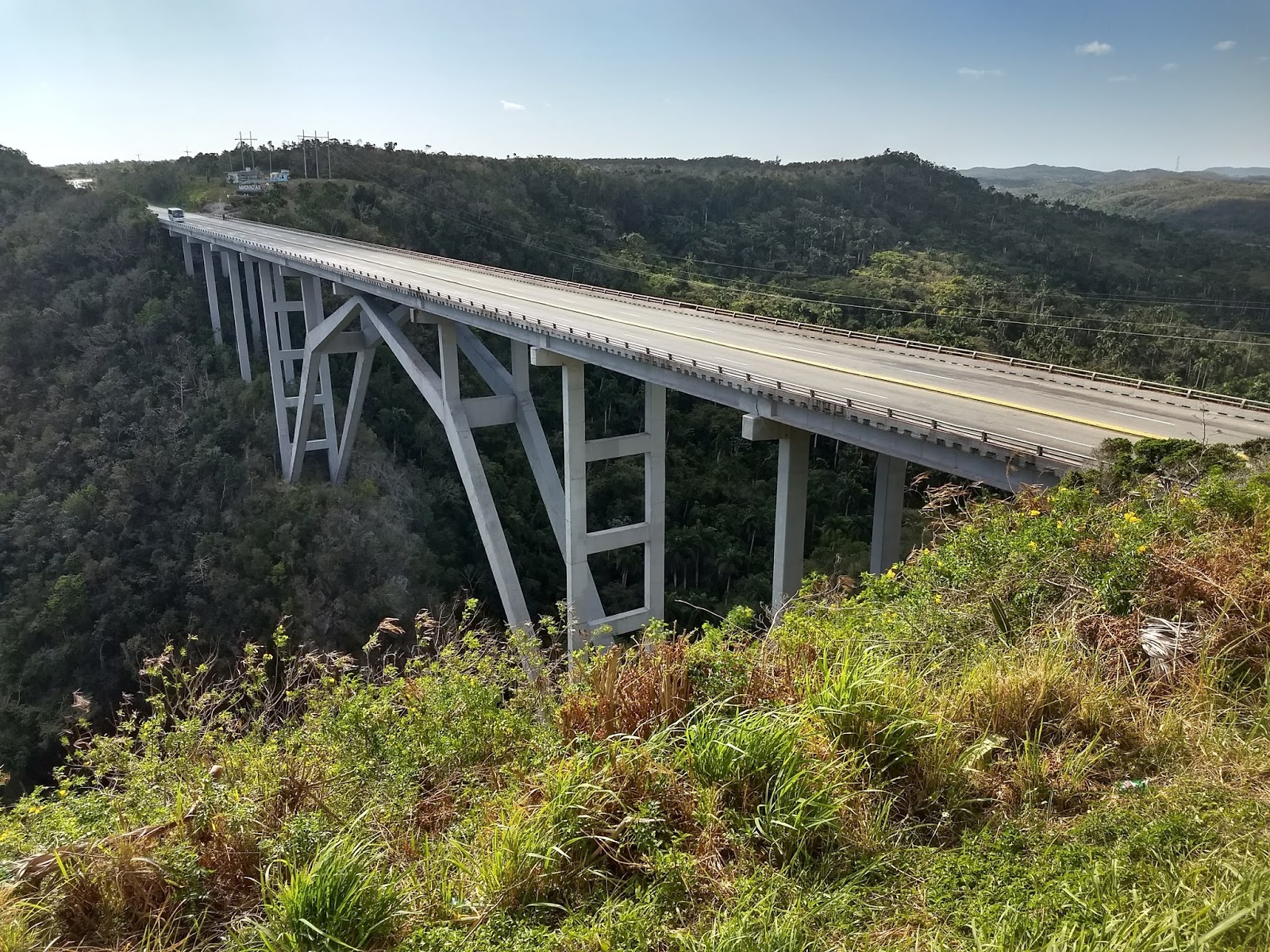
Havana is about 90 minutes drive from Varadero, but took about 2 hours with all the resort stops to gather the other tourists. Our driver, Julio, regaled us with tales of Cuba's people and history for the entire ride, and we stopped at the midway point to marvel at Cuba's highest bridge (112 m) at Bacunayagua, and to enjoy a pina colada served in a fresh pineapple.


We spent more time in the parking lot than the souvenir stands there, admiring the classic cars that canny and imaginative Cuban mechanics still keep rolling nearly 60 years after the last shipment of American parts.


The Bacunayagua bridge was actually engineered by the French, but along the way, Julio pointed out a number of other infrastructure projects (power stations in particular) built during Cuba's close association with Russia, or "Mama Roo-see-ya" as he put it. Russian tourists still make a point of journeying to Cuba, and there were a few posters with Cyrillic lettering in our hotel. The lobby clock even featured Moscow alongside Madrid and Havana:


Once in Havana, we stopped to look over the city and see the enormous marble Jesus statue (3rd largest in the world, I believe) that stands over the harbour.


And a cruise ship that seemed to dwarf even the city itself...


We toured New Havana first, seeing the massive expansion of the early 20th century, and the Hotel Sevilla where Al Capone would stay while in Havana, taking the entire 6th floor for his retinue.


The opulence and craftsmanship of this period is astonishing, right down the the tilework in the lobby.


How incongruous then to see the Revolutionary Museum right across the street. We had no time to go in but through the window, we could see the now-legendary yacht, The Granma. This tiny cabin cruiser took the Castros, Che Gueverra and nearly 80 other rebels from Mexico to Cuba to begin the overthrow of Batista and is now practically enshrined. The tanks, missiles and planes (British Sea Furies, actually) from the Bay of Pigs invasion are also displayed.


Most of Cuba enjoys a - let's call it 'relaxed' attitude to upkeep, and it would be easy to describe a lot of the buildings we saw as shabby by Canadian standards. On the other hand, no one in Havana is likely to freeze to death in December, so some of that attitude is understandable, and of course, they are still cleaning up after Hurricane Irma just last year.

The contrast between these two perpendicular streets was so striking I felt I had to get a picture of them; one looking like a postcard, the other almost post-apocalyptic, separated by 90 degrees and almost as many feet.

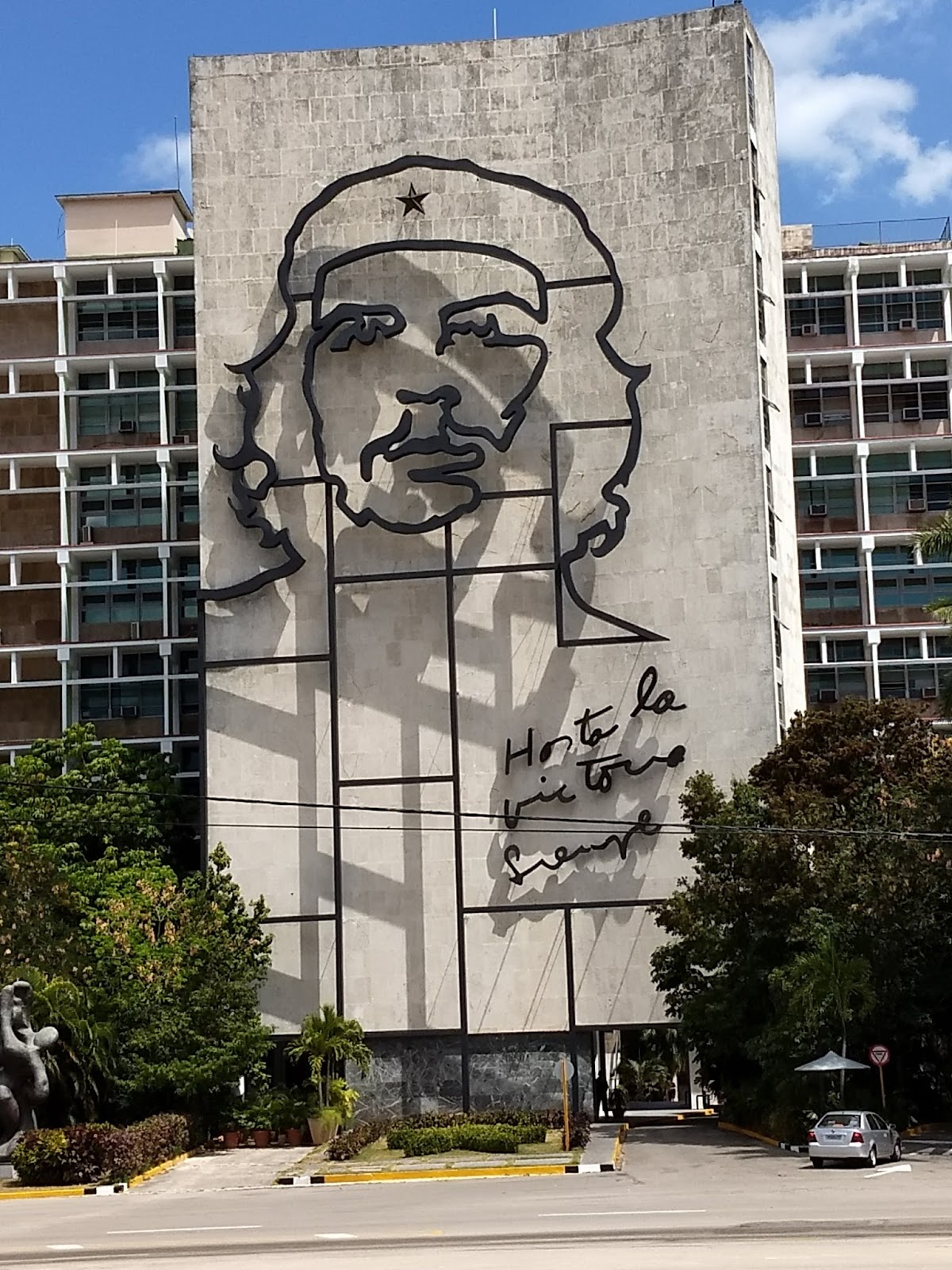
Our last stop in New Havana was the Revolutionary Plaza, the immense square where Fidel Castro delivered so many speeches at the foot of the Jose Marti Memorial. One of them went for over 7 hours, we were told!

Directly opposite the memorial stands the Ministry of the Interior building with an enormous depiction of Che, still revered here in a way that would make Elvis jealous.


After the plaza it was time for lunch at La Pina de Plata, with time for a delicious daiquiri made at the same bar that made them for Hemingway. The daiquiri originated in Cuba, and is named after a beach and iron mine near Santiago de Cuba, so we felt kind of obligated to have one there (but I would have had more, given the time and opportunity).


Shortly after this, we stopped in at the Rome y Julieta cigar factory, which Julio assured us was the only way to get proper "Habanos" despite the nearly constant offerings from helpful folks on the street, trying to catch your ear with a conspiratorial whisper. This, we were told, was a good way to get a masterfully wrapped collection of banana leaves, if that happened to be your thing. We got a couple for gifts, and I held a Cohiba back for myself, on the odd chance I get brave enough to try it at some point.


After that, it was on to Old Havana, skipping the 19th century completely and seeing buildings that went back all the way to the 16th, and the original Spanish colonists.

The former governor's mansion is now a civic museum, and elegant building that had me thinking I had wandered into a bonus level for Uncharted or some such.


Just outside the museum, Julio showed us how the governor dealt with what he felt to be excessively noisy horse's hooves: a road cobbled with wood instead of stone, maybe the only one in the world.


Inside we barely had enough time to take in all the artifacts, from the two enormous marble bathtubs they brought over from Europe to the mahogany Jesus and other religious items from the original cathedral.


The cathedral stands empty in the old town square now. Castro himself was Catholic, but his insistence upon a firm division between church and state upset the diocese of the day and they left.


Our guide, like most modern Cubans, is a non-believer, but says there has been a bit of a resurgence due to two recent papal visits: Francis in 2015 and Benedict (who he jokingly referred to as "Ex-Benedict" due to his retirement) in 2012. John Paul II visited there in 1998 as well, the first since the revolution.

In addition to that though, there is also a new blossoming of Afro-Cuban religious beliefs, including Santeria. Two practitioners sat in the square as we finished our tour, reading palms, telling fortunes, offering a variety of intercessions.


Like most other things we saw in Havana, they mixed the old and the new adroitly.

If we should ever return to Cuba, I intend to spend much more time in Havana, having lost most of our free time frantically searching for a power adapter for my CPAP machine. It is a fascinating city with an intriguing history I would love to learn more about.

Plus, you know, daiquiris.

Monday, April 2, 2018

The Many Drinks of Coastal Cuba

Driving away from Starbucks today, I mused to Audrey that my latte would be the first coffee I'd had in over a week that didn't have brandy in it, which really put a sharp frame around the whole all-inclusive experience.

I certainly don't think we overdid it at any one point, but we took full advantage of the fact that friendly bartenders were at our beck and call at the resort, and that there would be no tab. Indeed, I had to caution the most frugal of my inner voices that I was not 'leaving money on the table' every time I drank a non-alcoholic beverage.

Cubans take pride in their rum, cigars and coffee, in no particular order. Their two beers, Cristal and Bucanero are not necessarily bad, but really do need to be ice cold to be most enjoyable, so tropical drinks were really the order of the day. In particular, the piña colada, made with pineapple juice, rum, and coconut rum.

They are a bit sweet, but the liberal application of rum works wonders against this in my experience. The tiny glasses that make up the standard serving size can be a bit frustrating, especially when traipsing to and from the beach, but we streamlined the process by procuring our own reusable cups: a bright green plastic jobby for Audrey, and a bamboo mug with the Bucanero logo on it for myself.

Of course, none of these could hold a candle to the coladas we bought from a rest stop at Bacunayagua on our way to Havana, as these ones came in a fresh pineapple, and we could drink them while watching traffic cross Cuba's tallest bridge (112 m).


While in Havana, we also had the chance to try a daiquiri in a restaurant that shares a kitchen with Hemingway's favourite bar, where many a daiquiri was vanquished by the famous writer during his time residing here.


Back at the resort, Audrey tended to stick to the pina coladas, while I was intent on trying as many different tropical drinks as possible: margaritas, Cuba libres, Havana especials, and mojitos. There is also a rum-based liqueur called Elixir de Cuba which I tried straight up over ice, and enjoyed enough that I brought home a bottle.

The town of Varadero, close to our resort, has a place called The House of Rum, selling a wide selection of rums and cigars. But with prices set by the government, the small shop in our hotel had much of the same product at the same price.

Such easy access is a real mixed blessing, as my relationship with Demon Rum has been tumultuous, and even fractious at times. I like to think of this picture as showing the two of us making amends, but only time will tell, I suppose.


In terms of rum, Havana Club is the brand you see advertised the most, and see on the most t-shirts and bath towels and the like. Julio, our Havana tour guide, assured me that, given the choice, most Cubans would actually drink Santiago, so I purchased a small bottle of their añejo (aged rum) as well.

Back in the lobby bar of Arenas Doradas, we spent a couple of evenings making our way though the drinks menu and playing a very pleasant game of cribbage.


Not particularly fancy, but like I said, friendly staff, no tab, and some occasionally interesting characters who would pass by:


And in the morning, the coffee bar would only too willing to serve up a café español (coffee with rum and brandy) with a little flourish on top.