Showing posts with label work. Show all posts

Sunday, May 6, 2018

Dis/Closure and Sudden Departures

As the years went by, we drifted apart 
When I heard that he was gone 
I felt a shadow cross my heart 
But he's nobody's
Hero - is the voice of reason 
Against the howling mob 
Hero - feels the pride of purpose 
In the unrewarding job 
-Nobody's Hero, Rush
They let my rabbi go on Tuesday.

Rabbi is a term I picked up from David Simon's brilliant tv series The Wire. Baltimore Police officers in that program used the term to describe superiors in the department who had taken an interest in their careers, acting as mentors, advocates, interveners or coaches as the situation dictated.

My rabbi mentored a number of people in my workplace, and was renowned as one of the better 'people managers' in the organization. When the last org chart shuffle left him without anyone reporting directly to him, many of us wondered what the future might hold, but he ended up shepherding a major strategic plan for over a year. The plan involved interviews, an all-hands offsite workshop, and unprecedented collaboration across all levels of the company. It was a pleasure to work on, honestly, and those sentiments were echoed by many others.

But that project wrapped up earlier this year, and on Tuesday we found out he had been let go, along with two other mid-level executives.

Well wishes were disbursed appropriately, and an explanatory email from the boss made it crystal clear that this was not a reflection on anyone's work, but, rather, an existential need to move the organization in a new direction.

True or not though, all I could think of after finding out was what an ignominious end it was for someone who had been so instrumental in moving us to our current culture.

It reminded me of when I had left GW a decade ago; after the initial shock of being told I was leaving the company I had served for over a decade (and moved across the country for on two occasions) had worn off, I believed it was probably for the best. My biggest lament was not being able to attend the big staff conference and tournament being held down east that same week in order to say goodbye.

I'd asked about attending as a guest, and my boss and the HR manager who had accompanied him sifted uncomfortably and said that it wouldn't be possible. And I get it; even with the best of intentions, who's to say I wouldn't let my emotions overcome my better nature once I was actually there, saying goodbye for the last time, confronted with the finality and perceived judgement of it, and undoubtedly socially lubricated by comrades wanting to buy me a drink? No right-thinking leader is going to greenlight a scenario with so many potential sticking points.

But to this day, I deeply regret not being permitted that opportunity for closure. And now I am on the other side of it as my rabbi is forced, without warning or preamble, to wholly reconsider his place in the workforce.

Those of us left behind, colleagues, mentees, beneficiaries of the rabbi's wisdom and insight, have discussed it in hushed terms, and while none of us are particularly shocked, we are all surprised and saddened. It is universally accepted that the suddenness of his departure is discreditable, and reflects poorly upon the organization.

But no one has a reasonable alternative.

I read about some workplaces, in certain situations, giving soon-to-be-ex employees a future end date for their employment. If agreed upon, both parties would have the right to terminate the agreement if certain conditions weren't met by either party, e.g. "Two people have told us about how you made them uncomfortable by either talking smack about your bosses or pressuring them to join your multi-level marketing opportunity, so we are rescinding 1 week of the severance pay in your package and letting you go today instead of next Friday."

I'm sure just coming up with a suitable arrangement would be hellaciously difficult in most situations, to say nothing about how to enforce it, and the challenge of keeping things agreeable until the day of departure. It does create an environment slightly more conducive for closure though, which is something the human element on both sides of this equation will crave.

It's not unlike a death, I suppose. Despite the fact that no one involved is permanently beyond the veil or out of reach, the sudden and dramatic change in the workplace and relationships that have grown out of it are significantly impacted. The outplaced individual has to undergo a sudden and unpleasant reevaluation of their abilities, their goals, and their very selves, while those still in the workplace have cause to question the loyalty of their organization and the very real possibility that their own departure may play out in a similar fashion. Depending on the specific circumstances, a chance to say goodbye might not even help, but on the whole, what would you prefer for yourself?

There is a story about a family that owned a pair of dogs, and when one became ill and had to be put down, the other dog was acting out of character and upset, displaying bad behavior. This continued until the vet advised bringing her in to see the body of their other pet. They did this, and the surviving animal sniffed the body of her counterpart and satisfied herself as to his fate. Afterwards, there was a discernible period of sadness, but a notable improvement afterwards.

If even a simple animal benefits from this manner of closure, why would we deny it to ourselves, even in something as impermanent as a workplace dismissal?

I recognize there are no simple solutions, but I encourage everyone reading this to talk it up with their workplace superiors and HR people; maybe together we can put together a better alternative to sudden emails wishing a suddenly-former colleague all the best in their future endeavours.

In the meantime though, my workplace is now without a gifted individual deeply committed to the well-being of not only the organization, but the individuals who make it up. Days later, I still have to remind myself that I can't ask my rabbi a certain question, or share a certain insight, because he is no longer there because of the shifting vicissitudes of corporate life, and at this particular moment, I find that intrinsically crappy and unfair.

I am confident the rabbi will end up all right, in the same way I know that a person I see taking a painful fall is probably going to walk away from it, albeit with a limp, but that knowledge doesn't make it any more pleasant to witness.

Good luck Rabbi, and thanks for everything. You leave a lot of grateful folk in your wake who are better people now than when they met you. Please remember that despite the way things have played out, there are countless instances in which you are somebody's hero.

Sunday, June 11, 2017

You Are Who You Follow

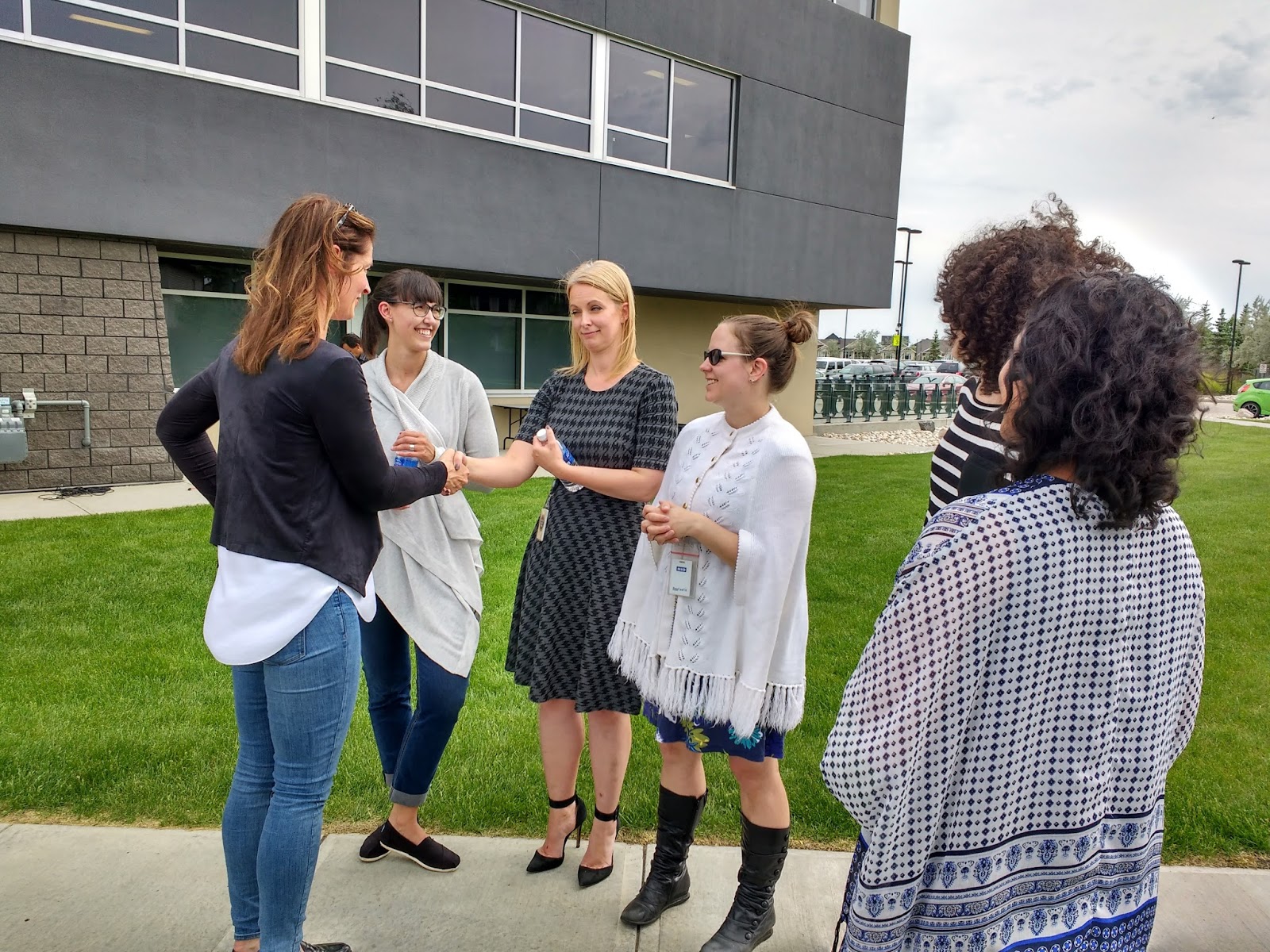
It was a bittersweet day at work last Thursday, as we said goodbye to our CEO for the past 5 years, Karen Adams. A lot of people had anticipated last year that she would be leaving after the completion of our massive technological project called Compass. We implemented it early last year, but she announced last fall she had been asked to stay on and had agreed.

However, that was before the new provincial government rolled out new guidelines for the heads of agencies, boards and commissions (ABCs). Since staying on after that would have meant a 30-40% drop in pay, well, I don't think anyone blamed Karen for taking another CEO position with a mutual fund company back east.

It's difficult for me to articulate my relationship with Karen. When she first arrived, she was my boss's boss's boss's boss. She spent the first 90 days just trying to learn as much about the place, and the work we did, and the people who did it, as she could. She met with me as I was developing our first quality assurance program. I was pretty excited about it, as well as the work I was also doing on our engagement committee, and I guess it must have showed, because near the end of the meeting, she looked directly at me, and said, "I bet you're a great dad."

Now, I don't believe I've ever actually claimed to be a great dad, but I've made it no secret that I really want to be one. I was gobsmacked that this stranger, four levels above me on the org chart, could not only see my true priorities so clearly but could also make a casual assessment about me that I would find so gratifying.

So, yeah, from that moment on, Karen had a pretty loyal follower in me.

Shortly after that we had our first corporate summit, a company-wide meeting at the local Cineplex where everyone could hear the same message at the same time, something else I am a firm believer in. Later summits had skits and tremendously involved presentations, often mimicking popular tv shows like Oprah, or Late Night with David Letterman, but the first one was a bit more stripped down.

Karen needed to go over her speech a couple of times because she doesn't like to work with notes, so we retreated into the higher seats, away from where the sound board was being set up, so she could rehearse her content, and even asked me for feedback. It wasn't until afterwards I wondered why she would pick me for that, when there were executive assistants and vice-presidents galore for her to choose from. Regardless, I was flattered and grateful for a chance to contribute.

I worked with Karen and her staff on several summits afterwards, and even got to give feedback on off-site speeches she often gave, which is what eventually led to me taking a job in our Stakeholder Relations department (formerly communications), and reporting directly to her for a few months prior to getting our own director.

As a leader, Karen has a firm idea of what is important to an organization (people) and what isn't (autocracy). She knows what she wants, but is always willing to listen to alternative points of view. Unlike several leaders I can think of, Karen can have her mind changed on a course of action, provided you can make a good case for a better one.

Despite having all the drive and focus you would associate with anyone at her level of responsibility, Karen's leadership included tremendous amounts of joy and whimsy. Within 24 hours of getting into it with a staffer over the merits of Coke vs. Pepsi, she had arranged a lunchtime Pepsi Challenge that over 150 people participated in. She could often be found cracking jokes with members of the staff as she made her way about the building, and her speeches included a number of well-delivered quips, as well as a genuine feeling of sincerity. I was astonished and touched when I saw she had written a glowing recommendation on my LinkedIn profile earlier in the week.

The combination of her departure and fear of the unknown in terms of our next CEO has taken its toll in many ways, so Thursday's send off was pretty bittersweet. We (mostly) respected Karen's wishes not to have too gushy or emotional of a farewell, limiting the commemorations to three short addresses by our three other executives, each accompanied by a small gift.

I guess because of my involvement in Toastmasters and my work with Karen on the summits and some of her speeches, I was asked to have 3-4 minutes of material on hand in case we got rained out and had to entertain folks indoors. The initial ask was a little vague ("I dunno, some jokes or a poem or something...") but after thinking about what I might say to acknowledge Karen's leadership and what her absence might mean for us going forward, I had an outline I was happy with and figured I could flesh out the rest on the fly if need be.

Last Thursday was the warmest day of the week, so I guess I needn't have worried.  I also knew that the EA who had asked me to be on stand-by had already caught some side-eye from Karen about the scheduled presentations, so I resigned myself to the fact that I wouldn't get a chance to do my little bit.

They did need someone to get things started and keep things moving, so I did a minimal amount of emceeing and then stepped out of the way so the thankings and the giftings could happen. Some of those voices were thickened with emotion, and I was grateful for the minimalism of our tributes. Afterwards I mingled with other staff while eating cake shots.

Eventually Karen wandered over to thank me and say goodbye, and I mentioned that I had been asked to speak if we got rained out. I told her that somehow I had managed to come up with a short bit that I felt captured most of how I felt about Karen's leadership and how it has prepared us for a future without her, and  I said, "...so if you ever want to hear it and you have 4 minutes to spare, you just need to let me know."

"Like a command performance sort of thing?" she asked.

"Exactly!" I laughed.

She looked at her watch for a second, then back at me. "How about now?"

"Like...right now?" I stammered.

"Like right now," she confirmed.


I hesitated, pointing her to a group of staff that I knew had been waiting for their chance to say goodbye, but as soon as she was done with them, she came straight back to me, and one of the Executive Directors who had wandered over.

"So you really want me to bust this out on you right here?" I asked, a bit nervously.

Karen nodded. "I really want you to bust it on me right here." She looked around, asking, "Do we need a bigger audience for this, or...?"

I took a look; most of the staff had left, and the majority of those who remained were board members I didn't know and a handful of executives, and I didn't want to make too big a deal of this than it was already becoming. I looked at Jon the E.D., who nodded his willingness to stay, and said, "This is good right here," and I started before a crowd could form.


Leadership is a funny thing. You can find yourself leading from a variety of places, like in the middle, or from the rear, especially if you are herding sheep. You might find yourself at the front of a group because everyone else around you took a big step backwards. 

But there are some people who need to be at the front, who have that combination of vision and persuasion and charisma that make it easy for other to follow them, even if they aren't precisely sure where they are being led to.

I think a lot about a Confederate general during the U.S. Civil War, Lewis B. Armistead, who fought at Gettysburg under Robert E. Lee. During Pickett's Charge, Armistead led his brigade from the front, taking his men across almost a mile of withering Union fire: bullets, cannons, and grapeshot. The smoke from the black powder weapons was so thick and the terror so palpable that he fashioned a makeshift standard by sticking his sabre through his own hat and yelling, "Follow me boys, and give them the cold steel!"

Armistead's brigade was the only unit to break the Union lines that day, but they could not hold it, and he himself was mortally wounded during the counterattack. There is a stone marker where he fell, and roses are left there to this day by admirers of his bravery. Those who followed him boasted about it for the rest of their lives.

Karen leads from the front too, under far less dangerous circumstances, obviously, but not without a degree of uncertainty and fear. She brought a clarity of vision to our workplace, not just about the kind of business we want to be and how we go about it, but the kind of environment we want to work within. She has had a profound impact upon our culture, and the way we interact with each other.

An organizational structure is kind of like a nervous system, and if you look closely at a group of nerves, you'll notice that they never actually touch; there's nothing there, it's a gap called a synapse. That space between is the most critical part of our neural impulses, the same way the interactions between us help define the organizations we work within.  Karen has built a culture of openness and respect, a breeding ground for new ideas that can come from anywhere, and not just the top.

We talk a lot about "you are what you eat", but I am beginning to think it might be more accurate to say, "you are who you follow". We should be careful about where we place our loyalties, and proud when we do so judiciously. But when you get to the top of the structure, who do the leaders follow?

If you are lucky, they follow values.

Karen has been a champion of values-based leadership since coming here, and not just our corporate values like Quality, Service and Accountability, but other, personal values I have come to expect from the leaders I choose to follow and not just work for. Values like honesty. Courage. Humility. Gratitude.

Karen has these values in spades, and has pointed to them throughout her time here as our leader. Now she is leaving, and that sucks, but the values remain, easy for us to find because Karen has pointed them out to us, like a compass. Navigating the way to a secure future, a better way of doing things, is the greatest gift a leader can give to her subordinates, and Karen has given us that.

Thank you Karen, for the leadership you've shown us, the gifts you've given us, and the values that will keep us moving forward after you've gone.


Karen's face was kind of crestfallen when I finished, and I was terrified that I had either overstepped my bounds, missed the point, or disappointed her with my hastily cobbled together speech, but this was not the case. "We totally should have had everyone hear that!" she cried. "Why didn't you say that when you were at the mic?"

"Well, it might have been because somebody was getting pretty upset at the amount of presentations and speeches already being done..." I offered.

A chagrined nod of complicity, "It was me, wasn't it?"

"I'm afraid so."

She thanked me for my words and my assistance over the years and gave me a hug. We had a few more words, and then said our goodbyes. I'm dearly going to miss that lady and the conversations I had with her.

I've been lucky to have had some great bosses over the years, all of whom have taught me something about leadership in some fashion, albeit in very different ways. I'm fervently hoping that this continues to be the case, but the truth is, Karen's shoes are not only big ones to fill, but have heels on them too. Here's hoping for the best!


Sunday, February 12, 2017

Picture of a Man at Work

It's an old picture, torn from the pages of the September 1995 issue of Premiere magazine (remember that one? It's been off the newsstands since 2007) and tucked into a three-ring page protector. I rediscovered across it in the bookshelf cupboard in the Batcave while tidying up the other day.

It's a picture of Robert Rodriguez, one of my favourite directors. He's made a lot of movies I've really enjoyed over the years, most notably Desperado with Antonio Banderas and Salma Hayek, probably the sexiest action pic ever made. He made his first movie, El Mariachi, for a reported budget of $7,000, on mostly borrowed equipment, which he financed by being a paid subject of medical experiments (and where he met the man he cast as the villain!).

His repertoire has a ridiculous range, second only to George Miller in my estimation, directing violent affairs like Machete and Planet Terror right alongside the family-friendly Spy Kids franchise. But while all of these facets make him cool, they aren't what make him one of my favourite directors.

It's his character.

Comic creator Frank Miller has a well-deserved reputation as a bit of a difficult crank to work with, and had expressed disbelief that anyone could adapt his own works in a satisfying manner. Rodriguez again used his own money and a volunteer cast to create a short based on Miller's brutal but brilliant noir crime story, Sin City. Miller loved it and agreed to co-direct a feature film with Rodriguez.

But the Director's Guild of America does not permit co-directing, so Rodriguez quit the DGA in order to make the movie in a manner that satisfied both himself and the property's creator. Although he did subsequently rejoin, it was a poignant statement about creative independence.

As evidenced in the Black Mamba commercial he shot for Nike with Kobe Bryant, Robert Rodriguez is someone who takes his work seriously, but doesn't take himself seriously.


But neither that anecdote nor a funny, self-aware shoe commercial is  what makes him  one of my favourite directors. And the picture always reminds of just what it is that distinguishes him in my eyes.

It was taken by Brian Smith during the filming of Desperado. Rodriguez looks just impossibly badass despite the fact that it is a staged shot. He wears cargo shorts and a grey t-shirt, accessorized by a fisherman's vest full of lenses, and a red bandana tied around his head kerchief-style to keep the hair out of his eyes. He has a bandage on his nose (covering the two stitches he got from an altercation with a viewfinder), but the most notable feature is the steadicam he is holding, attached to the harness on his chest. The dramatic backdrop, a flaming Lincoln situated mere feet behind him, completes the effect.


The accompanying article talks about his difficulty in moving from an indie film like El Mariachi to a big-budget actioner from a major studio. How he annoyed some reps from Columbia because he claimed he didn't know what an AD (Assistant Director) was. How he kept even this larger budget under control by casting a cameraman as a cancer patient. How he took a three day course in steadicam operation so he could take the shots himself to save both time and money.

The bulk of my admiration, though, comes from a single anecdote: with rapidly diminishing light, Rodriguez determined a superior angle to shoot a scene. His production assistant said there was no time to move the dolly tracks that would allow the camera to move laterally in a smooth enough fashion to capture the pan the director wanted, and said they would simply have to keep the shot they already have.

Rodriguez surveyed the ground, framed up what he wanted in his mind's eye and said, "Nah, get me a shopping cart and a steadicam, and I'll do it myself."

I don't know what I like more about this tiny tale, this microscopic Tinseltown fable; the fact that Rodriguez had such a clear picture of the shot he desired, or that he was able to come up with such a creative and unconventional way to get it.

Sometimes I struggle to determine what the heck it is I want, as I am sure many of us do from time to time, and when I do know, I will often take the path of least resistance to get it. Not every time, to be sure, but enough to annoy myself in retrospect.

Looking at that picture of a man who not only has a clear vision, but has equipped himself in a way that removes as many obstacles between him and it as possible is, to me at least, inspirational. That's why I tore it it from a magazine that I bought in Edmonton so I could have it in view on my desk in Mississauga while working in sales for Games Workshop.

This overly dramatic image of a man I have so little in common with is a great reminder of the importance of vision, the value of persuasion and persistence, and the notion that there are nearly an infinite number of ways to accomplish most things. Important ideas, these, and timeless.

So much so, in fact, that I think I will bring it to work tomorrow.

Monday, February 8, 2016

The Sadness of Fruit

Under normal circumstances, I don’t ascribe any particular amount of emotional resonance to fruit,either generally or in specific, but when getting the groceries this week, adding a small package of blueberries to the cart actually made me a bit, well, blue, actually.

The stage was set for this turn of events earlier in the week, when I had occasion to pick Fenya up from work. Since the end of the Christmas break, she has worked a fairly consistent rotation of Monday-Wednesday-Friday shifts, which go from 4-8. This means she takes the bus straight to work from school, and then sups afterwards. With choir practice on Tuesday and Thursday evenings, it makes for a busy week, but she has a double spare every other morning so she is able to keep on top of her schoolwork.

It’s a short drive from Education Station to our house, but the bus routes are not very cooperative, so Audrey or myself are fine with nipping over and picking her up, sometimes dropping the Corolla off in the parking lot so we can attend a meeting or go to a movie or what have you.

The overall effect though, has been a significant decrease in the number of interactions I get with my firstborn. And as she contemplates moving out of town for her gap year in order to save for university, I am becoming all too aware of the fact that, as much as things have changed in the past year, next year’s paradigm shift in our household dynamics will be even more pronounced.

I am very grateful that despite my apprehensions about the inscrutability of teenage girls that has persisted in my mindset since childhood, Fenya and I have somehow managed to maintain a good level of open communication. Early on in my parenting, I had resigned myself to the inevitability of becoming largely irrelevant once my inability to offer meaningful insights into style, makeup, or popular music made itself known, but have been gratified that both girls still find occasion to actually ask my opinion on things.

Because of this, it was uncomfortable but not awkward to confess to Fenya on the brief drive home that, regardless of what happens in in July of this year, I’ve already begun to miss her.

There was a brief beat, then she put her hand on top of mine where it rested on the gear shift, and said quietly, “Yeah, me too.”

It didn’t really change anything, but that validation actually helped quite a bit; the realization that this important connection, although strained by circumstance, remains intact.

“But what has any of this got to do with blueberries?” I hear my ten of readers wondering. Well, nothing, really; at least, not initially.


Due to a huge project at work being implemented at the end of May, there have been a few disadvantageous impacts on my work schedule, one of which is that I am losing (temporarily, I am assured), my compressed work week. This is an arrangement that allows me to work a longer day in exchange for getting every other Friday off. I never availed myself of this benefit when I was downtown, as it would have meant missing the last bus out of the Government Transit Centre, but once the office relocated to Windermere and I needed to drive there, I saw it as a way to reduce my work-related fuel bill by ten percent while keeping the same vehicle. It’s also nice to not use up leave time for things like medical or dental appointments.

The other thing the compressed day off allowed me to do was to send all three of my girls off to their respective schools with a hot breakfast once or twice a month, and with this being Fenya’s grade 12 year, well, that is something I am really going to miss.

Thankfully the change doesn’t take effect for two more weeks, giving me one final Friday off this week, which I have earmarked for some manner of early morning griddlework.

So when I walked into Safeway this weekend to sort out the weekly provisioning, one of the first things I saw was that blueberries were on sale, and with my general inclination towards bargains coupled with the rapid rise in produce prices as of late, I initially felt that slight tingle where perhaps my ancestors’ hunter/gatherer receptors experienced the elation of a discovery that meant postponing immediate starvation for at least some period of time.

As I began picking through the plastic containers, however, I experienced the maudlin observation that this could very well be the last time I have the opportunity to make such a purchase for a weekday breakfast for four. It's a small thing, a negligible thing, and yet, it made a significant impact on my psyche.

I felt pretty foolish, standing there in the entrance to Safeway, a small clamshell of blueberries in each hand, marveling at the rapid increase in my ocular humidity, but quickly managed to put it aside. After all, if the worst feeling I experienced that day was the realization that things change, and that change often has to come with a cost, I really have no cause to complain, do I?


And yet, I had to move the blueberries to the bottom of the drawer, so as not to be reminded every time I open the fridge.

Strange world, isn't it? Or maybe it is just the people?

Sunday, October 11, 2015

Honoring a Mentor, and More - Mark Chytracek

I learned this weekend that Mark Chytracek, who was a big part of my life while at Augustana University College, passed away from a sudden heart attack Friday night. The depth of my grief may seem surprising, considering we had only laid eyes on each other a handful of times in the last decade or so, but in terms of men who have had an impact on my life, Mark was probably second only to my father. His unanticipated passing has left me gutted.


Mark and Brandi Chytracek

Post-secondary education is a formative period in our lives, and my life was certainly no exception.  I took a year off before starting at Camrose Lutheran College (as it was known then), and was working 32 hours a week at the airport as a pre-board screening officer while taking a full classload. It was manageable, if not enjoyable, but I was planning to transfer over to the University of Alberta in 1-2 years anyhow. In truth the only reason I was working so much was to keep up my car payments, and the only real reason I needed a car was to get to work. This realization left me determined to get more out of my college experience, so I applied to the Residence Life Program, and after being hired by the outgoing Director of Student Services at the end of the school year, I met Mark at the Resident Assistant (RA) Training Retreat that summer.

Truth be told, I felt a little out of place amongst many of the passionate, fired-up young people I met there, but Mark made double-sure that everyone felt welcome, everyone had a chance to contribute, everyone was valued. His wife Brandi, a teacher, was in attendance for much of the weekend, and I learned very quickly that what they were trying to create on campus was less of a staff and more of a family.

You see, Mark and Brandi (and eventually three children) actually lived in a wing of one of the student residences, so the Residence Life program was about a lot more than just employment to them, and as a result, being an RA became more than just a job to most of us.

Mark`s training program was fairly intense, but an enjoyable experience despite all that, using a lot of storytelling and roleplays to help us, as student leaders, to create an environment of of respect.  Being a dry campus, there was an emphasis on being firm with students caught with alcohol and the like, and I know Mark`s role would have seen him bear witness to a fair amount of students leaving school under less than ideal circumstances.  I also know though, that he was also the god of second chances for many people, and that he went to bat for those whom he felt could make the most of such an opportunity.

In three years of working with Mark, I never heard him raise his voice in anger, even though I saw him get terribly frustrated at times.  I never saw him lash out and then apologize, despite being confronted with behaviour that sometimes bordered on the insane. Mark may have expressed disappointment with a behaviour or an incident or a policy, but I don't think I ever saw it crystallize into an ad hominem or personal grudge; Mark was the one who taught me how `hate the sin, love the sinner`was supposed to work.

His matter-of-fact approach to matters like this, and his appreciation of the importance of grace in our lives, meant that Mark is also one of three people I credit with bringing me back to faith, after a period of spiritual dormancy and cynicism. He and Brandi were active in their church, often serving as youth leaders, but never proselytizing, never judging, never bible thumping. Secure in their faith, comfortable in expressing it, but respectful of the beliefs of others, their belief was an important part of their lives that they simply didn't feel the need to make a big fuss about.

Mark lived responsibility, and made other people want to do so as well. I remember him talking about being in the Costco parking lot shortly after a terrible child abduction incident had been in the papers, and seeing a man struggle with a young child. He headed over there quickly and purposefully, and saw some other men doing the same thing.  The man in question, who did turn out to be the child's father, was initially indignant, but Mark apologized for the confusion and explained his motivation while many of the others nodded, and the dad ended up thanking them for getting involved.

Mark positively impacted the lives of countless students and employees, myself included, often seeing things within us we couldn't see for ourselves.  I asked him for a letter of recommendation after graduating, which he gladly provided, and in which he wrote, "During his year as President of the Student's Union, I was impressed with Steve's manner in dealing with difficult and/or uncomfortable situations. His ability to respond to people in a genuine way is a real gift." A gift I hadn't given any conscious thought or focus to, but which I have since tried to make the cornerstone of my interactions with others.

I watched Mark and Brandi, a young couple with young children, raise two families at Augustana over the years: their own, and the generations of students whose lives they touched. Working with Mark meant meetings in his dormitory apartment, sometimes holding a baby while he and Brandi sorted something else out, or sampling chili for a long weekend's football game. The gentle give and take between them, the teamwork where leadership could shift contextually, and the fact that they could disagree passionately on matters but still work constructively towards a solution without animosity; these all helped me form a picture of what a successful married life should look like.

When Audrey and I were living in Toronto, Mark was in town for a conference, and came over one evening to visit; I can't remember how it came about, but I am so glad it did.  We caught up over a beer and had a few laughs, and Mark asked how married life was treating us, as we had only gotten married  4 years prior.  Things were good, and I told Mark so, but I also made a point of thanking him for that, and telling him that he and Brandi had a bigger role in modelling what marriage and family life could be than anyone in my life except my mother and father.

I think he was a little embarrassed, but he also knew I was sincere, and took the compliment graciously, as he always did.  Had I not, I probably never would have had the opportunity, life being what it is, and I would now have an additional reason to be sad.

In college, as now, humour was the lens that let me make sense of the world and connect with other people, Mark and I were both huge fans of comedy and the way it let you explore uncomfortable truths about ourselves and the world we live in, and he loved to laugh.  I loved to make people laugh, so perhaps it was inevitable that we would get along as well as we did.  Mark laughed easily and generously, the contagious kind of laugh that doesn't care how it makes the wielder look or sound, and encouraged anyone in earshot to join in, even if they didn't know why.

At the end of RA training, there was group work that needed to be presented back to everyone, and I was nominated as our spokesperson. I cannot recall either the topic or the manner in which I delivered it, but I tried to make it funny and memorable, and thanks to Mark, I did.

I can clearly picture him,  shoulders heaving as he wheezed with laughter, his reddened face slick with tears, one hand clutching his aching ribs, the other held palm up in a traffic cop's 'Stop' gesture and shaking his head in the hope that I would give him a chance to catch his breath...but of course I couldn't, could I?

His reaction probably had as much to do with the clinical levels of sleep deprivation endemic to such retreats as to anything in particular I was saying or doing, but I loved him for his laughter all the same.

A few years later, when Audrey and I got married in the campus chapel, Mark was there, and came to the mic at the reception to relate the tale of how I had once felt compelled to sit, suddenly and without warning, in a dishwasher, at one of Rob F's legendary spring break hot tub parties. He didn't ascribe this to a state of inebriation (though he might well have), but more an indicator as to my sense of whimsy and impetuousness. Mark's delivery was earnest and loving, which got everyone laughing, including himself, probably from watching me trying to withdraw my head into my tuxedo jacket like some kind of turtle.

It's hard to write this, knowing the opportunity to hear that laughter again is forever lost.


There may be someone who played a role in your life like Mark did in mine; if you haven't already, I beg you to let them know.  Don't assume they already do - give them a call, drop them an email, poke them on LinkedIn or Facebook or whatever and make sure.

I don't even know for certain how old Mark was, but it doesn't matter because he is gone far, far too soon.  He was, and would have continued to be, an exemplary grandfather, and would have made one hell of an old man, because he was a hell of a man, full stop. I picture him in a now unrealized dotage, trying to pull off a curmudgeonly Col. Potter from M*A*S*H (one of his favourite shows), but not fooling anyone.

Being a part of Mark and Brandi's campus family was an honor and a privilege, but that tremendous influence on such an important part of my life almost makes it feel I have lost another father. Mark leaves behind a grieving wife and three brilliantly raised children, but also a legacy of service and community that I cannot imagine being equaled; we should all strive to leave as much when our time comes.

Sunday, January 18, 2015

Transitions

Here in Alberta, where we, collectively, have no idea how to manage our natural resources compared to, say, Norway, there are a lot of nostalgic sounds making a comeback:
-the sub-glottal gulps of pundits and economists, wondering just how much lower oil prices can go, and what this might mean.
-the slithery clicks of multiple belts being tightened.
-the clattering rumble of ideological wagons being drawn into a circle, as governments and unions begin circling them in anticipation of government budget shortfalls, and the cuts likely to follow.
-the silence of breaths being held by virtually everyone as we all ponder what new development might be next in our fiscal dramas, both macro and micro, both as spectators and as participants.
Suncor has already laid off 1,000 people, 17,000 more people at Target stores nationwide will soon be looking for work, and a recession at this point is beginning to look inevitable.

With Audrey working in a school, and myself at a Crown Corporation, our futures aren't grim by any means, but they are certainly more tentative than they were a month or so back.  Most of the people I know have spent parts of their adult lives unexpectedly looking for work, and we all agree: we'd far rather work at a job we didn't love than spend our days seeking employment.

My own circumstance came in 2007, at the end of more than a decade working for Games Workshop. I had worked up through some leadership positions at the headquarters in Mississauga, then transitioned to retail to facilitate moving back to Alberta in 1999.  I managed a store in Edmonton, then oversaw both stores, and ended up looking after all of Western Canada, from Winnipeg to Victoria.

I loved visiting the shops, talking to staff, sharing insights with the various store managers, but in truth, didn't enjoy it as much as I had my previous roles.  Something about managing from a distance didn't really suit me, and as I struggled to deal with the baggage of store managers I hadn't hired, I was already wondering if the time had come for GW and I to part ways.

It turns out I wasn't the only one thinking that.

I thought it was unusual that my boss, the Head of Retail, was coming to Edmonton only a week before I was scheduled to head to HQ for a conference, along with the rest of the retail managers.  When I discovered that the head of HR was coming with him, well, I didn't exactly need spider-sense to determine that things were awry.

They strolled into the West Edmonton Mall store that I operated out of most days, and after exchanging pleasantries with the rest of the staff, we left the store to go chat.  Normally, this involved a trip to the Tim Hortons franchise located above the ice rink, but my suspicions were confirmed when we bypassed it, and made our way to the hotel.

The room they were using was large enough to have a table we could sit at, and sensing a need to lighten the moment, I made some sort of quip about the fact that if the door opened up onto a single bed with the covers turned down, they were going to be in for the fight of their lives.

They both chuckled, but my boss moved quickly to the topic at hand; the retail chain was not doing as well as it had in the past, and the western stores were no exception.  There was a real need to make some significant changes, and the long and the short of it was, my position was being eliminated.  When the comprehensive reorganization was completed, my number one subordinate and former assistant manager would be looking after the western stores.

It was blunt, but I appreciated the brevity of it.  My boss explained that I would receive a severance package, and that he had arranged for my health benefits to be maintained for another two and a half months, which I know he would have been under absolutely no obligation to do.  He and the head of HR would come to my home that evening to collect the company vehicle (a Dodge Caravan, used primarily for hauling gaming tables and stock from store to store), my company phone, and any personnel files or other administrative items not in the shop.

Given the circumstances, I can't say I was surprised at this turn of events, but it was still rather shocking.  I had been looking forward to seeing my comrades at the conference next week, but now wouldn't even have the opportunity to say goodbye to their faces.  Still, despite being inevitable, my departure was still being treated with respect, which I appreciated immensely; I was simultaneously crestfallen and grateful.  I accepted the terms of the severance package, completed the paperwork, and not long after that, we were making our way back to the store.

I told my boss that leaving the company was only the second worst outcome I had foreseen for our meeting, and he asked me what would have been worse.  "You telling me that you were being let go," I told him, "Because I would have felt responsible for it, at least in part."

He had always been a hard fellow to catch wrongfooted, but his soft reply of "oh, wow," suggested I might have finally done it.

My boss and I had always had a good relationship; we each took what the other said with a grain of salt sometimes, but knew we could always count on the other for honesty and directness.  The GW culture was almost startlingly informal at times, with many a conference devolving into lager-fueled escapades and shenanigans, but it turns out you can very quickly determine the cut of a man's jib by playing games and drinking with him; in vino veritas and all that.  There was a clear demar cation of authority in our interactions, but I considered (and still consider!) him a friend.

He broke the uncomfortable silence on the way back by saying, "It's been a while since we talked, and there's all this other non-work stuff I want to ask you about, but now it all feels like, 'aside from that Mrs. Lincoln, how was the play?', y'know?"

Despite it all, I had to laugh, and we paid serious attention to trivial matters for the remainder of our walk.  When we got back to the store, I collected my things, said so long to the staff as though leaving for the day, and left the two from HQ to explain what had happened, as we had arranged.

As I drove home, I wondered how best to break the news to Audrey, then ended up spending an hour in a slushy parking lot waiting for AMA to come change the tire on the Caravan, When I finally got home, earlier than expected, I don't recall exactly what I said to her, but it was something along the lines of "I don't work for GW any more."

Understandably, her reaction was shock, and fear:  "What are we going to do?"

No 'are you okay?', not 'how?' or 'what happened?' just an immediate leap to defensive panic.  And after everything else, that was just more than I could take.  I raised my voice, we both got a little upset, but only briefly, and when I explained the severance package and benefit situation, she was able to look at the situation with a little less panic and a little more hope.

Shortly after that, the phone rang; it was my number two man, and he was beside himself, upset, I think, as much with the suddenness of my departure as the rationale for it. I reassured him that while I was nowhere near happy with the situation, I understood the company's position, and did not feel I was being treated harshly or unjustly; it was just unfortunate.  I can't help but think that if I had been less convincing, he might have up and quit on them, despite just having been promoted, and there is a strange sort of gratification that comes from that.

By the time the Ontarians came by to pick up the van that evening, I was feeling much less desperate and wounded, and far more philosophical about the entire affair; so much so, in fact, that I invited them in for a beer, and to my surprise and delight, they agreed.

Walking downstairs, my (former) boss noted all the balloons on the walls, and asked just how much of a happy face I was putting on the whole situation.  I explained that we weren't celebrating my unanticipated departure from retail, but today had been Glory's fifth birthday, and saw him wince.

The head of HR had started with GW as a store manager prior to becoming the retail boss and then migrating to HR, and over a beer, the three of us discussed some of the more acrimonious partings our company (and we ourselves, at times!) had witnessed over the years.  After a few head-shaking recollections and even more belly laughs, he wrapped it up by saying, "At least this time, when people ask me how it went, I can say, truthfully, that I have never seen a guy act with more integrity."

I`m a fortunate man, in that people have had occasion to say kind and flattering things to and about me over the years, but that one really took me aback.  I`m experiencing a little ocular humidity now, just in recalling it.

They finished their beers, and I thanked them for everything, and they did likewise, and for the first time as an adult, I found myself unemployed.

Sure, things eventually worked out, and I escaped retail, and I am with a good organization now and hope to be with them for a good long while, but there was a lot of tension and uncertainty in the middle parts there, I don`t mind telling you.

And as the clouds of uncertainty boil along the horizon, and the prevailing winds begin to build from that direction as well, we are reminded of the one thing that is certain: things will probably get worse before they get better.

But on the other hand, they are likely to get better before they get worse again; the trick is just finding a way to hang in there until they do.

Tuesday, October 28, 2014

Hard, At Work

I'm sure there are probably some exceptions, but I imagine that every job under the sun has its share of ups and downs; even the most rewarding of positions comes with its share of bad news to be broken, even the best of fits has a portion of lamentable administration.

I'm in a new role in my workplace, as an educator, and although I find elements of it highly rewarding, it has been a harder adjustment than I would like to admit. A big reason for this is probably ego; having come from a position where I implemented a program of my own design and a fair amount of latitude, I now find myself learning massive amounts of new information and struggling to keep up at times, and having to ask for assistance with unfamiliar new tasks.

Obviously, a period of adjustment is only natural, and my new colleagues and superiors are only too happy to give me any support I need, but I'm still uncomfortable needing it, as ridiculous as that may seem. On the plus side, those I am instructing have responded very favourably, and with as much patience as anyone could ask for.

At the end of the day, working with good people is about as much as any of us can ask for, and on the days when things have gone imperfectly, I think to myself, hey, at least I am not a doctor, and had a patient die on table, or maybe a police officer who had to go home after defending himself with his sidearm.

Or my wife, working for far less pay as an educational assistant in a school that continues to challenge her despite having been there for six years.

The new school year is not yet two months old, and yet Audrey has now held marijuana for the first time in her life, after taking a suspicious substance away from a student. (It was a pair of sixth graders who confirmed what it was for her.). She has discovered that 4 of the students she knows are victims of sexual abuse, and that in some cases, the attacker was a relative.

One of her students stopped eating for the weekend, and was, unsurprisingly, feeling ill today. Audrey discovered some of the boys, led by a particularly vicious youngster, have been taunting her and calling her fat, despite the fact that she has a build close to that of my youngest daughter (who I can't even describe as 'pleasantly plump' with a straight face). When Audrey sat down with the girl to explain why she can't simply stop eating for days at a time, she discovered that the girl's father, a 45 year old diabetic, recently had both his legs amputated, and has essentially given up on living and wishes to die.

"It's even more important then, that you stay strong: for you, and for your father," Audrey told her.

Hearing about the situations these children face every day, and knowing that Audrey is confronted with them on a regular basis, makes it churlish for me to dwell at all on whatever shortcomings I might face in the workplace. But even for her, it isn't all bad; today, her sixth graders used subtraction to figure out her age, and quite a few of them were surprised at the result.

Apparently, there is balm in Gilead; sometimes a little recognition and compassion can go a long way in salving a bruised world.

Tuesday, September 16, 2014

Ice Bucket Doggerel

Late in August, as the trend was at its peak, a couple of people where I work organized an Ice Bucket Challenge in benefit of ALS research.


This trend of challenging others to douse themselves with icy cold water has now run its course, and that is probably just as well, but I am very glad we participated. There was some spectacular trash talking, an excellent display of leadership from everyone involved (from the Executive level to the trenches!), a wonderful time shared outside on one of the last really warm days of the summer, but most importantly, $3000 was raised that might not have been otherwise.


The video at this link shows the highlights; it's funnier if you know the people involved, but even if you don't, it's worth skipping to the 2:15 mark to see how our boss kicks it off!


The whole thing came together in under a week, and I was so impressed by the efforts displayed, I was moved to verse. Not good verse or anything, but for the twenty minutes after lunch spent putting it together, it made a few people smile.


We’ve seen lots of cool things at our Windermere place

But today made it hard to maintain a straight face

When a challenge gets dropped and an event created

To see so many colleagues get so marinated


Dihydrogen monoxide saturation

Is shocking on just about every occasion

Even more so, I’m reliably told

When said liquid is almost solid from cold


With water that’s practically refrigerated

We’re glad no one had to get defibrillated

Grimaces, flinches, but no attempts to abort

Goes a long way to show that our crew are good sports


ALS is a monster that strikes without warning

But knowledge gets spread through these ice-buckets pouring

The staff will queue up for cold water parity

And raise three thousand dollars for such a great charity


Showing bravery, humility, grace and compassion

Our leaders (and others!) stepped forth to take action

Admit it, when faced with that threat of ice bucket

Most of us would probably just say…


…“Well, at least it’s for a good cause.”