Monday, February 4, 2013

Muse Concert: 2nd Lawful Good

Playing the 'what do you think they will open with?' game before a concert is always a lot of fun. Will it be an old favourite, or something from the new album? Will it be slow and dramatic, or heavy and bombastic? At last night's Muse concert, the answer to the first question was something new, and the answer to the second was 'yes'.
I had said that if they led off with a track from the 2nd Law, their latest album, then the lead single ("Madness") was too slow, so my hope would be for either the brilliantly Bond-like "Supremacy" or the cinematic/dubstep instrumental "The 2nd Law: Unsustainable". These turned out to be the first two songs played, only in reverse order. "Unsustainable" was a great choice, as it opens with a simple yet urgent guitar rhythm, punctuated by ominous fanfares, while a female newsreader's voice intones a litany of entropy, climaxing with the assertion that 'an economy based on endless growth is UNSUSTAINABLE', the last word being usurped by a Cylonish vocoder, and that's when you get The Drop.

Muse has a reputation for both dynamic live shows and creative and imaginative staging, and this tour did not disappoint on either count. A circular bank of video monitors wrapped around the stage behind the band at their feet, while another ran underneath the stage at floor level. The real visual treat came during the third song, "Supermassive Black Hole", when an inverted pyramid of monitors and lights descended from the ceiling, and I half expected Roy Neary to climb out of it.
There were fewer lasers this time than the 2010 concert, but if anything, this staging was even more creative and engaging. As the song "Animals" played, the banner monitor displayed a stock ticker while the pyramid played scenes portraying the rise and fall of a greedy or careless broker. Near the end of the concert, the circular bank turned into a roulette wheel displaying two songs from the back catalogue. Sure enough,when the 'ball' had dropped into "Stockholm Syndrome", the band obligingly tore into it like a kid opening a birthday present. A very playful way to end the pre-encore set, even if it made me sad knowing I wouldn't be hearing "New Born", which had opened the last tour. The only other disappointment for me was not getting to hear "Hysteria" live, as it has one of the all-time greatest bass lines in rock. Still, I did get to hear one of my favourites from "Black Holes and Revelations", the album that introduced me to Muse, when they played "Map of the Problematique".
Even though some of the people I attended with were there as fans of spectacle more so than of the band itself, we all agreed it was truly an epic show. Even the opening act, Britain's Band of Skulls, made a good impression on most of us. I'm surprised and a bit saddened that the show wasn't sold out, especially as Muse recently sold out three nights at the Staples Centre in Los Angeles. Sandra Sperounes of the Edmonton Journal estimated the crowd at a mere 7,000; surely the Superbowl couldn't account for that, could it? Thankfully,what crowd there was more than made up for its size with a vocal appreciation for the band.
The whole darned family came with the lads and I last night (and Rev. James, the biggest Muse fan I know), and Fenya and Glory both had a great time at their first real rock concert. Glory even splurged so she could get her first concert tour t-shirt, while the more practically-minded Fenya picked up a very sharp looking water bottle. We all went to great lengths afterwards to explain that not all rock shows will be like this, and they should probably set the bar significantly lower for the next concert they attend.
I am insatiably curious as to where Muse will progress musically next; as Pete said last night, "The 2nd Law" appears to have at least a half-dozen iterations of the same band: rock, funk, dubstep, balladeers, Bond, and so on. They already sound distinct from the band that recorded "Black Holes and Revelations" only two albums ago, despite having been together for almost two decades now. As long as their live shows continue to be this energetic and entertaining though, I will not be missing any.

Sunday, February 3, 2013

A Classic Confrontation

After months of procrastination and a hectic set of winter holidays, Earl, Sean and I finally got together to try playing the Star Fleet version of the A Call to Arms space battle game. Sean's miniatures are very nearly completed, and Earl used some newly purchased technical pens to put the names and striping onto his Federation vessels.

Sean's Romulans were hampered by the fact that we were trying to avoid using the advanced rules, which of course include his strategic lynchpin, the dreaded cloaking device. Despite this, his King Eagle heavy cruiser still managed to cripple Earl's USS Excalibur.

For the second game, I took on the (presumably repaired and refitted) Excalibur with my Klingon D7, the Battlecruiser Vengeance. By this point, Earl had become a lot more familiar with the Special Actions available to him, which are really the heart of the game: each turn, before moving your ship, you can attempt to give a special order, such as Boost Energy to Shields!, or Close Blast Doors!, which will give certain benefits, such as replenishing damaged shields or granting a 5+ save against any damage taken that turn. Sometimes you won't want to take a Special Action, since they may drain your power and limit your movement or offensive capability. They can even involve a dice roll with punitive repercussions for failing, such as when he attempted a High Energy Turn! And ended up not only turning shallower than intended, but damaging his impulse drive to boot.

For my part, I would quite often sit down after having moved my ship only to curse at the realization that I had neglected to give the order that could have repaired my shields. Thankfully, the inability of Captain Woods to beat my dice rolls for initiative meant that I enjoyed the tactical advantage of moving last in all but three or four turns of combat, and I was able to eke out a narrow victory.
With both of us having given the order to Overload Weapons! (which doubles the damage done by photon torpedoes and disruptors), Earl moved his Constitution class heavy cruiser into a decent enough position, but I instead opted to move straight backwards, putting me into his aft starboard quarter, and out of the firing arc of his deadly torpedoes. My D7 opened up, and blew Excalibur's superstructure apart, limping away from the battlefield with no shields and only one hull point left before being crippled itself.

We had quite a bit of fun, even without using any terrain (planets, asteroids, gas clouds) and only one ship apiece. As we increase the size of our engagements and the amount of rules we use, I am certain our enjoyment will only increase. The A Call to Arms rules use a very simple set of base mechanics which are then supplemented by a number of attributes and exceptions that make the sequence of play very easy to follow, even if it takes a little time for everyone to figure out what the different ship and weapons traits actually mean.

In fact, even the rules for Cloaking Devices look surprising straightforward; instead of secretly plotting your moves in writing, your model remains on the table, ignoring weapons fire on a roll of 2+. Once you disengage your cloak, however, it can be moved up to 6" in any direction, and turned up to 45 degrees, meaning that opponents only have an approximate idea where a cloaked ship may be, and a cagy Romulan player will always wait until winning initiative to uncloak, and very likely get a fatal drop on them with the intensely unpleasant plasma torpedo.

There are plans afoot for a multi-ship encounter at G&G VIII with nothing but D7s and Constitutions, which I think could be a lot of fun, but in the meantime, I can't wait for the next opportunity to test my tiny fleet. I am certain Capt. Woods is clamouring for a rematch as well!

Saturday, February 2, 2013

The Adventures of Gub Wootini

At long last, the girls and I finally took advantage of the Star Wars: Identities exhibit at the Telus World of Science.  It is a world class bit of curation and edutainment, and I strongly suggest checking out before it moves on in early April.

In addition to hosting a plethora of original props, maquettes and artwork dating all the way back to production of the first film in 1975, the exhibit also takes attendees on an exploration of identity, the various elements of our heritage and environment that help to determine who we are.

There are numerous comparisons between the prequel's main character, Anakin Skywalker, and his son Luke from the original trilogy (which made me feel a little bad for not having watched them at all with Glory).  Despite similarities in their genetic makeup, sharing the same homeworld, and both losing family members at a young age, Luke and Anakin couldn't be more different.


As you proceed through the exhibit, you are actually given the opportunity to create your own denizen of the Star Wars universe, which, despite my continued apprehensions about the prequels, continues to be a colourful and fascinating place to explore and inhabit.  You choose everything from race and gender, to the parenting style you were raised with and culture of your homeworld, through friends and mentors, and on to a randomly determined event, like having your home planet destroyed (as happened to my Mon Calamari,  Dubb Steffra ), or winning a city in a game of chance (which happened to Fenya's Nautolan, Nallah).  Glory's Ewok, Gub Wootini, ended up chained to the belly of a crimelord, but managed to throttle him and escape.  Good thing she saw Return of the Jedi recently, eh?

At each stage, there is a short video, which had a lot of neat insights into current thinking as to how our culture, occupation, personality and values factor into the decisions we make, which in turn are so intrinsic in determining who we are.  The audioguides you wear automatically pick up the appropriate soundtrack for each station, and a bracelet records all the choices you make for your creation.  At the end, you are given the choice of joining or rejecting the Emperor, and can then see your character and their story projected onto a large display screen.  They also provide links so you can view them at home or share them with friends.  I find myself thinking that this process would be a great mechanic for creating characters for a tabletop role-playing game, as opposed to optimizing dice roles and crafting a background to fit.


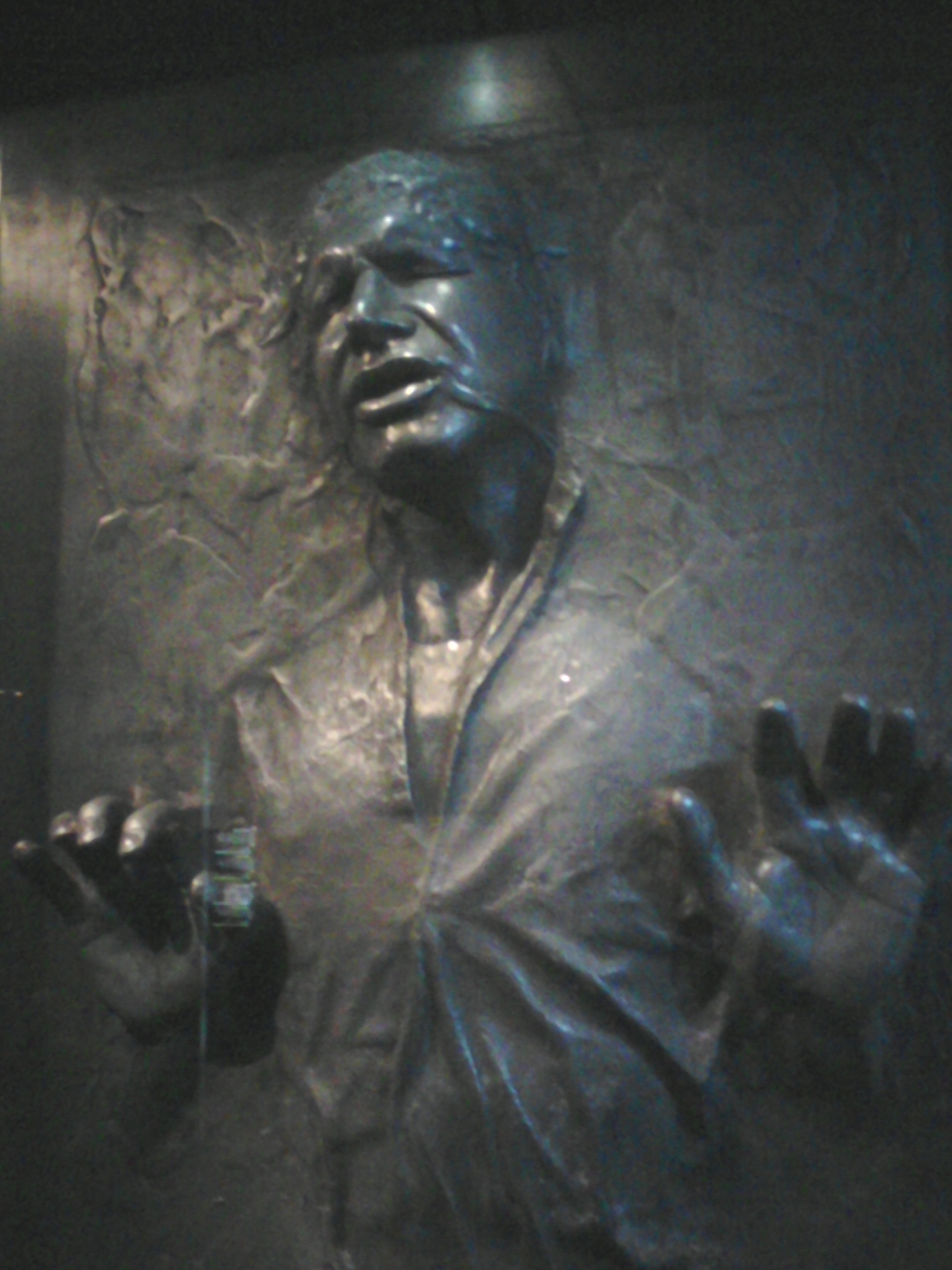
The exhibits are very well presented and include not only props and costumes and such, but also some interesting insights into the challenges of creating the movies, some of which I had never heard before, despite having been interested in the topic since I was 9 years old.  There is a bit of a thrill seeing one of the original Han Solo in carbonite props, or Jabba the Hutt's eyes.  Being able to closely examine Boba Fett's bandolier, or a Stormtrooper's armour can bring back a lot of the wonder that drew me into George Lucas's universe to being with.

We watched the original trilogy last week in preparation of the visit, and the girls enjoyed seeing firsthand how much work goes into creating a cinematic setting as diverse and visually original as this one, but my favourite part was how many talking points the identity portion of the exhibit presented.  Why are our friends important to us?  How do the values we profess affect our choices?  Why do similar people react so differently to the same situation?

Following the destruction of his home planet, I decided Dubb Steffra should choose to dedicate himself to the preservation of its culture.  I couldn't tell you why I didn't choose the more adventurous path of joining the alliance and overthrowing the despot responsible, but at the time I had to choose, the notion of a planetary identity being completely extinguished, even a fictional one, seemed impossibly tragic.  Surely if that could be prevented, the despot could never truly accomplish his genocidal mission, could he?


For myself, the exhibits' narrator asserting that the difference between a mentor and an educator is the fact that a mentor educates through example and not just lessons should not have been a revelation, but it kind of was.  Who around us are we mentoring to and we don't even know it?

The exhibit's program asks us to consider 'what forces shape us?'  Star Wars is a fascinating filter to examine this question through, and anyone looking for insights into how both movies and people are made will find it worth spending an hour or two at this exhibition.

Sunday, January 27, 2013

In Defense of George

In anticipation of a visit to the Star Wars Identities Exhibit next Friday, the girls and I watched the film that started it all (also known as Episode IV: A New Hope) this afternoon.  I explained how George Lucas, for his third studio picture after THX-1138 and the far more popular and well received American Graffiti, had hoped to adapt the Flash Gordon serials of his youth, but was unable to obtain the rights to do so.

Having failed in this, he set out to create his own space opera, and influenced in equal parts by Joseph Campbell's "Hero with a Thousand Faces" and the films of Akira Kurosawa (especially The Hidden Fortress), managed to succeed beyond his wildest dreams.

Sure, looking back at how elements of the prequels and subsequent elements like the Clone Wars animated television series have diluted the brand for those of us who grew up on nothing but the original trilogy cuts an unforgiving silhouette of a man determined to wed art and commerce but unsure of how to do so.  But for all his foibles, and amidst all the celebrating and recriminating going on around the recent sale of his Lucasfilm studios to Disney, and the subsequent revelation that J.J Abrams will be directing a new Star Wars movie in the immediate future, it felt good to look back at the first film.  It might be good for us to recognize that George Lucas's success was far from accidental, however we may feel about his having squandered the potential of this particular franchise.


Cinematic Worldmaking - You can't say Star Wars as made on a shoestring budget, but the cantina scene in Star Wars shows a filmmaker and his colleagues pulling out all the stops to create a multi-species tableau in a way that future iterations of Star Trek and all their wrinkly foreheads never could.  It may have scored a C+ for effectiveness, given how few of the aliens had working mouths or eyes, but it certainly earns an A- for audacity.

Pictorial Chops - I'm sorry, but has anyone come up with a more iconic opening for a space picture than the ominous overtaking of the rebel blockade runner by the immensity of the Imperial Star Destroyer?  Watching that oppressive wedge descend from the top of the screen as well as the boarding action that follows makes we want to hop into my wayback machine to 1977 and just watch the faces of audience members having their minds blown.  After years of largely introspective, often insightful, but generally languid and recurrently boring science-fiction movies, someone had finally brought the scope and fun of the 1930s matinees back to the big screen!

Classic Tale - As the comic strip Penny Arcade has succinctly surmised, "Star Wars is about space wizards who live in the past-future." They're not wrong.  I tried to explain to the girls that there is only a hair's breadth difference between Star Wars and the story of King Arthur: young hero, secret heritage, elderly wizard mentor, magic sword, damsel in distress, impregnable castle... the list goes on.  Like James Cameron's Avatar, the familiarity of the story is part of what gives it lasting appeal.  Even without the prequels and such, the cultural footprint of Star Wars was never likely to be forgotten, in part because of the carefully measured timelessness of the tale.  If only the hairstyles were as immune to the march of years!

Used Future - To be honest, it is not as though there was a lot of competition at the time, but Lucas deserves come credit for presenting the first non-dystopian future where the technology looked used.  From the asymmetric (but still beautiful) Millennium Falcon with its scuffed interior and exposed cabling, to the scorch marks on the Incom T-65 Space Superiority Fighter (aka the X-Wing), Star Wars gave us a future with a past, where the spaceships and floating cars had mileage and a resale value, and maintenance was needed just to keep a ship in the air, not just to repair it after battle.

Steal from the Best - Many scenes from Star Wars echo Kurosawa's Hidden Fortress so perfectly as to practically be a homage, despite no credit being given.  Many of the shots from the climactic attack on the Death Star (especially the destruction of the attacking ships) were based on ones from The Battle of Britain.  While the lack of originality is unfortunate, you have to wonder how much added resonance this sort of attribution brought to the film, especially to young viewers like myself, who wouldn't see these other movies for years or even decades afterwards.

As a child in the fifth grade who had seen Star Wars multiple times over the summer, had you asked me what I would like to be when I grew up, I might have told you I was conflicted, since I couldn't decide between Jedi Knight or X-Wing pilot, and I was pretty sure only Luke Skywalker could be both.

Star Wars engendered in me a love of films and curiosity about how they are made that persists to this day.  It also created a curiosity about warrior cultures, especially the samurai of feudal Japan, which affected a lot of my learning and interests throughout my adolescence, and even into college.  Ben Kenobi's admiration of the lightsaber as being "Not as clumsy or as random as a blaster, but an elegant weapon for a more civilized age," was the lament of a Meiji-era samurai, facing obsolescence as gunpowder came to the fore.  His admonition to Luke to trust his feelings, to have faith in the force, was Lucas' own belief that "technology cannot save us", at least, not by itself.

Watching the force, an admittedly tenuous concept from the original trilogy, distilled into sentient micro-organisms dwelling in the bloodstreams of potential Jedi in the first prequel, was disappointing to me to be sure.  It didn't eradicate the joy of watching Qui-Gon Jinn and young Obi-Wan Kenobi derail an invasion all by themselves, or the satisfaction of watching a pupil avenge his master in the third act.  Watching Lucas struggle with the difficulties of bringing a legendary character such as Darth Vader through his adolescence and into a murderous adulthood though, that was too much to bear.  I haven't called myself a fan in years, and only saw the third prequel, Revenge of the Sith, last year, seven years after it arrived in theaters.

To be fair, the prequels and tv show have kept the brand alive and vibrant in a way that nostalgia alone never could, and the universe has remained a colourful and exciting place to explore in these mediums as well as video and computer games, toys and action figures, comics and novels.  In the end, it is (or at least was) Lucas's sandbox, so if he wants to build forts in it or just poop in it, that is up to him, right?

Forgetting for a moment the various editions, Han shooting first (or not), and the multitude of leaps needed to tie together a convoluted and arbitrary timeline and bloodline, the original trilogy, and especially that first film, still have a sense of wonder that a lot of other films have struggled to capture.  

There is still a lot of merit in visiting that far, far away galaxy from a long time ago, and I hope that with new hands on the lightspeed throttle, I might enjoy returning there again in a couple of years.

Tuesday, January 22, 2013

Les Miserables

I don't know if I would call myself a fan of the musical adaptation of Victor Hugo's classic novel, but I have seen three different productions of it, ranging from an astonishingly well-done high school version up to the national touring company that rolled through Edmonton years ago, and I have enjoyed them all.

Knowing that the musical's original producer, Cameron Mackintosh, is behind the recent theatrical release (or adaptation's adaptation as I like to call it), and that the stars all have varying degrees of singing ability and pedigree, it should be no surprise that the movie version of Les Miserables is well worth seeing, no matter how familiar you are with the original.

Obviously, you have to have at least a tolerance of the musical format; if you are one of those sad cases who feels obliged to point out how 'unrealistic' it is for people to burst into song, and where is that music coming from anyways?, you might as well give this one a miss, and go back to not wondering about how Stallone never needs to reload, or why stupid victims are needed to advance the plot for almost every horror movie.

The rest of us can be astonished at just how well Catwoman, Gladiator and Wolverine can carry a tune, and marvel even more at the fact that they are not lip syncing to a pre-recorded track. The performances were captured live, while the singers used tiny earphones to listen to a piano accompanist out of microphone range. This way, the performers could set the tempo, the pianist could compensate, and then the orchestral score was layered in over top.

Now, there are plenty of movies it is worthwhile for even blind people to see, or hear at least, but I don't know if this is one of them. Musical purists might be better served by listening to the Broadway or London cast recording instead. Director Tom Hooper (The King's Speech) takes full advantage of the medium, and fills the screen with shots of both impressive physical scale (like the opening scene, where Jean Val Jean (Hugh Jackman) and his work crew have been moved from the stage musical's generic field labours to the herculean task of hauling a massive ship into drydock) and compelling emotion (Anne Hathaway's haunting rendition of I Dreamed a Dream, which, while not accomplished on the first take as was rumoured, was done in one take with absolutely no cuts).

The acting is uniformly excellent: Russell Crowe's Javert is full of conflicted menace, Hathaway's Fantine is relentlessly tragic, and Jackman's Valjean is as compelling as any of the iterations I've come across, especially during his Soliloquy. Being able to emote was a face 27 feet tall gives the filmic medium a distinct advantage, just as being able to follow them on a chase through the streets, or into the sewers of Paris is. None of the stars can belt it out of the park like a Colm Wilkinson (who appears as the Bishop), but getting a good singing performance out of an actor can be a lot easier than the other way around. If you don't believe me, the Brothers Gibb in Sgt Pepper's Lonely Hearts Cub Band stand as exhibits A through C. At any rate, you end up with some tremendously moving scenes that stand up favourably to anything I've seen on stage. Sacha Baron Cohen and Helena Bonham Carter also do a wonderful turn as the larcenous and scene-stealing Thernardiers.

I took some exception to the insertion of a new song, Suddenly, as an obvious means of garnering Oscar momentum with an Original Song, but was mollified upon discovering that it was written by the original songwriters. And besides, it isn't as though it is a bad song, but I found myself being really critically minded towards its inclusion, what with the movie already running two-and-a-half hours and all. Les Mis was originally planned as a four hour movie, with the battle in the third act running 15 minutes on its own. As it sits, I think the film balances the epic and the intimate pretty much perfectly. Go, and bring a tissue or two.

Sunday, January 20, 2013

Fruitesque

I attended a workshop yesterday at my church, and as one of the exercises, we were asked to select a picture from an assortment of fruit images. The idea was to select one that you felt reflected you in some fashion, and then share with one other person what your rationale was.

I took a picture of a sliced kiwi fruit, and walked over to Philip, asking why he had chosen a pear. "Well, it could be because of my shape," he began, "but honestly, a pear has a lot of the same characteristics as an apple, so it is familiar, but it is different enough that it isn't so...I don't know, common?" I nodded in agreement. "Why did you take a kiwi?"

"They're fuzzy and a little funny looking, but still good," I replied. "They're not quite sweet, not quite sour, and often they are at their best when paired with something else, like strawberry-kiwi juice."

"Not bad," said Philip.

"Thanks. I thought we had to explain our choice to the whole group though; if I'd known it was just going to be us, I would have taken the strawberry."

He cocked an eyebrow and asked, "Why's that?"

"Because knowing how they are fertilized, it is encouraging to know that sometimes a bunch of bullshit can produce something pretty sweet."

During Operation Desert Storm, Gen. Norman Schwarzkopf responded to a reporter's suggestion of something completely unrealistic by saying, "I would categorize that statement as bovine scatology."

Dad had a set of moose antlers on a plaque in our family room when I was a child. I was too young to understand that the accreditation on the plaque stating it had been shot by my father with a .22 long rifle at a distance of 300 yards was patently absurd; even if the bullet could reach the beast at that range, it would be an annoyance and not a threat. He chided me about it in my teens one time; "C'mon Stephen, I would have thought the inscription gave it away, the one that says 'Excreta Taurus Fulgeat Sapientum'."

"I don't read Latin, Dad; what's it mean?"

"I was told it comes across as 'Bullshit Baffles Brains'..."

Sunday, January 13, 2013

Snownah Hex

Glory was at a slumber party last night, so when we picked her up after church, she was happy that Fenya had brought her a gingerbread snowman from this morning's activity. When she brought it into the house Fenya said, "Sorry Glory, but your snowman turned out looking like Jonah Hex."

Now, I knew his eyes were a little lopsided, but I thought it unlikely that the mouth shared Hex's disfigured grimace as well, but as I peered over, darned if I couldn't make out the resemblance! (Technically I guess it is a mirror image, but still, for happenstance it's pretty close, I thought.)

"Don't you think so too Mama?" Fenya asked, but Audrey just looked bewildered.

"Your mother doesn't know who that is sweetie." I explained. "Aww," said Fenya.

I took a lot away from this tiny (and surprisingly typical) exchange:

  1. The accuracy and perception of Fenya's characterization.
  2. The charming juxtaposition of a jolly confectionery snowman and a disfigured, macabre comic book bounty hunter.
  3. The fact that my eldest could end up being a pop culture monster, if only we paid more attention to the things that are popular now.
  4. Her sadness that her mother neither recognized nor appreciated the reference.
It's unfortunate to me that from a reference standpoint, far more people will now recognize this character from the recent (and apparently lacklustre) movie, as opposed to his true origins in DC Comics.
As a kid, I had a number of comic digests featuring the adventures of Jonah Hex, a cunning, ruthless and horribly disfigured bounty hunter. His adventures in post-Civil War America started out heavily inspired by the recent 'spaghetti westerns' of the time, eschewing the matinee idol looks of previous comic book cowboys like the Rawhide Kid in favour of an unshaven anti-hero, similar to Clint Eastwood's Man With No Name.

Jonah Hex was fast on the draw, and a deadly shot with either his twin Dragoons or a repeating Winchester, but his most deadly weapon was clearly his mind and both his tactical and strategic savvy. Any time you saw some owlhoot draw down on Hhex's silhouette and pull the trigger, long time readers would chuckle to themselves, knowing this rube had actually just shot a comrade that Hex had tied into his saddle and dressed in his battered old Confederate army jacket (although, even as a young man, I wondered how he kept finding tailors to wash out the blood and patch the numerous bullet holes...).

My favourite though, was how an adversary in a saloon might get the drop on Hex's back, only to have him turn around while lighting a stick of dynamite from his cigar. The TNT would be revealed to be a dud of some fashion, but only after Jonah used the momentary surprise to draw and fire, which would usually result in more bounty income.

Being a comic book, Jonah Hex could venture into stories that western movie and TV shows were unlikely to touch, like the one where he allies himself with a Meiji period samurai looking for his daughter. This may be the high water mark for me in terms of the number of fanboy elements hit; comic/western/history/samurai has probably only ever been trumped by the Kung-fu/action/comedy/romance/monster movie/ghost story Big Trouble In Little China.

Later on, as interest in comic book westerns waned, Hex saw himself reinvented; first, as a time traveling, post apocalyptic warrior (of which, the less said, the better), and later on as a western bounty hunter again, but in tales full of supernatural overtones. Most recently, as part of DC Comics universal reboot, Jonah Hex has teamed with Gotham City psychologist Amadeus Arkham (founder and eventual inhabitant of the infamous Arkham Asylum in the Batman comics), grappling with ruthless and depraved secret societies as he tracks a trio of murderous brothers from the plains to this strange city.

Sadly, I no longer have my trove of Jonah Hex digests, so Fenya mostly knows The character from his guest appearances in the DC Animated Universe, which makes it surprising that she would so quickly envision his visage on what would appear to most of us to be a fairly cheery snowman cookie. Still, even a ruthless and deformed western anti-hero can have a role to play during the holidays, wouldn't you think?

Uh, those boots in the corner of the cover notwithstanding, that is.