Showing posts with label television. Show all posts

Sunday, October 4, 2026

More Light But Less Bright - Lanterns, Reviewed

Spoiler-free, as always!

Given that modern Green Lantern comics are a rollicking space opera featuring the titular space cop using their immensely powerful ring to fight menaces even more terrifying than the ones we have to deal with IRL on Earth, such as an entire spectrum of power ring corps on an emotional spectrum, it is not too surprising that a lot of comic fans have decried HBO's more grounded Lanterns series, some calling it a travesty for the way it depicts one of its two characters: the original Silver Age GL, Hal Jordan (Kyle Chandler).

And you know what? Fair enough. If you tuned into the first live action series expecting a sci-fi buddy comedy in space, you were bound to be disappointed. If you were looking for a show picking up where animated predecessors like Justice League or Green Lantern, where the Hal and his traine/ replacement John Stewart (Aaron Pierre) have a barely masked antagonissm towards each other, you were bound to be a little bit put off. 

Or if you were anticipating a focus on adventure and wer then forced to 'settle' for an unsettling, time-jumping procedural featuring a deductive infiltrator investigation and murder mystery, one of which takes more than a decade to resolve, your disappointment makes sense to me. I see you.

I don't see you closely or super clearly though, because I really liked Lanterns.

I will not outline much of the plot becuase dang, they take their time playing this one out, and they pack a few great twists along the way, but I feel they tied things up, both logically and emotionally by the eighth episode and season finale.

They answer some great lore-type questions along the way, too, like "who is the real Green Lantern of sector 2814?" and "wait, how can there be more than one?", but that feels almost incidental.

The real story is about personal growth and courage, and the role fear has to play in that. As well as the role race has to play in fear. This prespective caused more than a few people to step off the fan train, calling the series woke and saying race politics has no place in a superhero adaptation.

This, despite the fact that when the character debuted in 1972, he was clearly an anti-authority figure committed to black empowerment, not unlike the Black Panther Party spokespeople of the day. And Neal Adams even had to fight to give John Stewart a darker skin tone than black characters had up until that point.

Taking a lot of cues from HBO's True Detective series in terms of tone and pacing, there is more than enough galactic scale and science-fiction shenanigans to differentiate it from other shows, even if they are a bit selective about overtly using the power ring and it's constructs a little sparingly. Chandler's arrogant crusty, worlde-weary test-pilot superhero has been critiqued as being too much of an asshole, but two things about that:

1) a lot of fighter jocks, especially test pilots, will tell you that ego is at least as big a part of their makeup as willpower (the core requisite of being a Green Lantern) and a lot of people will register that level of confidence as arrogance and yeah, potentially assholery.

2) there are times when John Stewart is every bit as much an asshole as Hal, and Pierre carries off the balance of fearlessness, frustration and ambition with considerable aplomb.

To tell you much more runs the risks of spoilers, which I will not do, so I will say this: Lanterns also has a similar feel to producer Damon Lindelof's brilliant Watchmen (2019) series, if you have any interest in a mature approach to questions like how do we determine the character of people carrying unimaginable power as well as what sort of tasks could challenge such individuals, then don't listen to the haters, many of whom are misguided and simple, but some of which are racist and oughta know better. 

Even if you are not that big on superheroes at the moment, check out Lanterns quickly before they announce season two and recap the finale in the headline or something else daft, and let me know what you think of it.

The contrast of darkness and light might entrance you, as it has me.

Sunday, January 25, 2026

Shoresy: A True and Vulgar Heart

The opening scene of the hockey comedy Shoresy (just wrapping up its fifth season on Crave and starting it stateside on Hulu in February) is an imaginary sports panel podcast that does a seamless job summing up both the titular character and the show itself:

1) Shoresy himself (Jared Keeso, co-creator and writer), who plays AA hockey in Sudbury, is a likely candidate for the dirtiest player in all of hockey, both on and off the ice, and

2) he also has a big, sentimental heart (exemplified by his crying every time he hears the national anthem), and visibly choking up on a few key moments even in the first season.

Having really enjoyed Keeso's breakout project Letterkenny, I don't rightly know why I slept so long on Shoresy. We got three months worth of Crave in January so we could watch season two of The Pitt and Knight of Seven Kingdoms, but when I was laid up after my molar extraction, it seemed a perfect opportunity to watch a show Glory had already seen and was confident I would like.

Two days later I had watched three of the five available seasons.

I am not surprised that I like it so much; it has the same rough, swear-y exterior and genuine warmth underneath that Letterkenny does, but exploring longer stories among a great supporting cast of colourful characters makes it even better, in my opinion. And while it isn't always funny, the smartness of the dialogue and laugh density is just tremendous.

What did surprise me was how much Audrey and Fenya enjoyed it, as I thought the rapid-fire, slang and expletive-filled dialogue would be too much for them. And Shoresy himself is by no means a 'good' guy - for most of the first couple seasons he is actually more like an anti-hero, a loose cannon you are happy to see directed at worse people or achieving collective good incidentally.

And yet, when Keeso brilliantly portrays Shoresy's resistance to genuine emotion in the first season finale, Fenya observed, "it is just ridiculous to me that an episode that opened with a crude sexual reference and literal poop humor can contain such genuine sentiment - how?!"

Regardless of how, we are all now die-hard fans of the show and the Sudbury Blueberry Bulldogs - enough so that three of us and Glory's bestie went to see the Shoresy Classic on Friday night.

Since everyone who skates on the show has real hockey experience (including a 7th overall draft pick and one with three Stanley Cup rings), they've started challenging NHL alumni teams to short games with part of the proceeds going to charity. Getting to see Goody, Hitch, Dolo, the Jims and the rest lace them up against the likes of Ales Hemsky, Georges Laraques, Fernando Pisani et al was a real treat, as was watching Keeso referee an Atoms game of 6-8 year-olds during the intermission.

It isn't great video but I had to share the beauty hotdog goal scored by Jacob "Fish" Smith in the shootout that began the second period.

The Bulldogs haven't won any of these games yet (they tied the Bruins 14 all), but despite losing 13-11 in Edmonton, they put 12,000 bums in seats (3.5K more than Cowtown!), raised $46,000 for the Oilers Community Foundation, and, as promised, skated a hard lap with their tarps off "for the broads."

After the game, Jonathan Ismael Diaby (Dolo) announced an after-party at Beercade on Whyte Ave (a venue choice that another fan described as "on-brand") that Glory and Fenya ended up going to, and where Glory ended up getting gifted a shot from Dolo himself, which was pretty cool.

To be clear, Shoresy is not a show for the easily offended, or maybe even one tier up from that, whatever you might call it. But behind the rude language and occasional objectification there is a sincere show with a lot of heart that has a lot to say about teamwork and perseverance sure, but also about community and personal growth. Maybe sacrifice too, since the handsome male lead had a tooth surgically removed to legitimize his hockey smile. It also shares Letterkenny's great knack for fast, smart dialogue and intriguing characters. 

And oh man, whatever the opposite of toxic masculinity is, as exemplified in this promo for the most recent season:

Plus solid and organic indigenous representation, strong female characters and plenty of references just for us noth of 49ers. Shoresy is great CanCon and a full season of six 20+ minute episodes is about the same time commitment as a movie; check it out if you get an opportunity.

Sunday, August 24, 2025

Livin' On the Dial...

Like a lot of people my age, I have an enormous soft spot in my heart for the sitcom WKRP in Cincinatti. It ran from 1978-1982, and like Star Trek, enjoyed greater success in syndication than it did in its original airings. 

Set at a midwestern radio station transitioning from an easy-listening to rock radio format, the show had so many great characters and interactions that it is hard to have a favourite. The writing was sharp, self-aware, and shifted from laughs to pathos without missing a beat, like when black disc jockey Venus Flytrap, coming to face the music as an army deserter, introduces the white station manager who's joined him for moral support as his father.

And the music! Rock that ran the gamut from classic to new wave, and all legitimate tracks by known artists. Debbie Harry's band Blondie actually credited the show playing their single Heart of Glass with helping to break it out, and presented the show with a gold record.

But that same verisimilitude was what ended up costing WKRP syndication immortality, as rebroadcast rights shifted or lapsed, and made it impossible to show the episodes without frankly brutal and nonsensical edits, and nixed home video releases.

With syndication now replaced by streaming, and access being limited wither outright piracy or the DVDs released a decade ago by Shout Factory with most of the original music (ooh, and on sale for $59.00 CAD as I write this! hmm...), I am surprised how WKRP remains relevant and maintains a fandom, but somehow it does.


In fact, one of those fans has done something marvelous as part of their Radio Retrofit project: they have stitched together three hours of ersatz radio content, hosted by the show's morning DJ, Dr. Johnny Fever (Howard Hesseman) working a simulated triple-shift. It opens with the choppy dial tuning and static from the show's intro ("-but the senator, while insisting he was not intoxicated, could not explain his nudity-") before launching into the wonderful theme song.

The other music is eclectic and solid, the intros and outros funny ("That's Bo Diddley playing a song called Bo Diddly, and why not? I can't imagine anyone doing it better..."), and best of all, they've included advertisements and news breaks with Les Nessman "...WINNER OF THE BUCKEYE NEWSHAWK AWARD," (Richard Sanders). 

It is a real labour of love that the individual has made available to play or download for free from their blog here. I listened through it today while we had company, and but even that intermittent exposure was enough to convince me to buy the producer a cup of coffee via PayPal. 

Music streaming means I don't listen to the radio a whole lot any more, and when I do it is often news or the listener-supported stations like CKUA with their extremely eclectic mixes. I still tune into the local modern rock/alternative station periodically but their playlist comes off as fairly repetitive even with my limited listens.

Make no mistake, listening to a fake DJ spin real music is nothing if not nostalgic, but maybe that's okay once in a while. The songs played range from 1955 to 1982, and both the time range as well as the variety of styles and tones remind me of a radio ecosystem that simply hasn't existed since. I'm amazed it existed at all, actually, and feel privileged to have experienced it.

In the meantime, I am fully aware of the irony of using a pocket digital computer to digitally play analog radio wirelessly in my vehicle, but that hasn't stopped me from doing it, and looking forward to my next long drive.

Sunday, April 6, 2025

_________, in the Blue Room, with the Knife - The Residence, Reviewed

Netflix's The Residence scratched a lot of itches for me, including the need to periodically binge a series, which I didn't even know I had.

But near the end of our Spring Break staycation, Audrey and I were looking for a show to watch, and the trailer had come up in my recommendations. As luck would have it, Fenya arrived back at home from an outing just before we sat down to watch the first of eight episodes before dinner on Saturday night.

We watched four more before going to bed and resolved to watch the remainder the following night, which we did.

The high-concept of "a murder, but in the White House" was enough to pique my interest, being a fan of shenanigans at 1660 Pennsylvania since The West Wing back in the day. I've never watched a Shondaland production before, but have heard great things about Bridgerton and Shonda Rimes alike, so that felt promising.

The story revolves around the murder of the White House's Chief Usher, A.B. Wynter (Giancarlo Esposito, who appears to be in everything now, and replaced Andre Braugher after his tragic passing) whose body is discovered in the Games Room on the same night as a state dinner for the Prime Minister of Australia. Consulting detective Cordelia Cupp (Uzo Aduba) is summoned from her planned bird-watching expedition, and has to deal with not only a seemingly impossible murder but all the political angles including an incredibly hostile Chief of Staff (Ken Marino) and an FBI agent (Randall Park) resolutely endeavouring to be useful but earning little more that exasperated tolerance from Cupp.

As murders go, it is a doozy, and switching perspectives from the events of that night to a senate inquiry months after the fact (chaired by former real-life Senator Al Franken!) puts an intriguing spin on it. But like the title says, the big seller here is the setting. From the sets themselves to the shots moving in and out of a meticulous model of the residential wing of the White House, I would still be inclined to believe you if you told me it had been shot on location. A former White House staffer gave them details about the areas that have never been photographed, and there are many details that give the entire affair a considerable veneer of credibility.

Of course, having all the legendary rooms, many of which are named for their dominant colour, come up in a murder mystery so often, the Clue comparisons are there for the taking as well.

Even if the setting has no interest to you, the amazing array of characters and the manner in which they drift in and out of the prime suspect box as the series progresses is similarly top rank. The quirks are maybe amplified as befits a murder-mystery comedy. The feuding chefs, one from a Michelin-starred Swiss resort, the other from a food truck in Portland are just two of several great examples.

Most critically of all, did they stick the landing? I definitely think so, yeah - enough so that Fenya and I may rewatch it just to make sure!

I'm not gonna lie; at this point in time, the idea of a murder in the White House is maybe a bit more compelling to people than it would've been, say 12 months ago? But whether you ration it out or binge it like we did, anyone who liked Knives Out or wants to explore a more profane take on Agatha Christie would do well to check out The Residence.

Sunday, February 12, 2023

Presenting the Complex

 Audrey recently finished watching the HBO mini-series Chernobyl, which has the same showrunner as our current infatuation The Last of Us. It is absolutely brilliant television, dramatically recreating one of the world's greatest industrial tragedies and the heroic efforts needed to undo a situation created by greed, ambition and secrecy.

But one of the highlights for me was the show trial at the end. The trial was a political requirement so the Soviet people (and to a lesser degree, the rest of the world) could rest assured that the culpable parties were punished, and thus, repetition of the accident practically impossible.

During the trial, atomic scientist Valery Legasov (Jared Harris) must explain the accident at Chernobyl Nuclear Power Plant #4 in such a way that the military, judicial and political judges understand it. Conveniently, this means he must also explain it in a manner so that the viewers (like myself) can also understand it. 

Legasov must do this without 3D computer animation (as there was no such thing in 1987) or any other technological crutches. That he manages to do so with a simple set of red and blue placards and a display board was absolutely spellbinding to me.

A reactor does two things, he explains: it increases reactivity (the red cards) and decreases reactivity (the blue cards). Uranium atoms begin splitting (red) but then boron control rods dampen the reaction (blue). He takes us through a normal set of reactions and controls and the resulting generation of electrical power, demonstrating the complex balancing act keeping everything in check. 

He then recreates the accident, which saw power levels lowered, which then created a series of effects that removed a number of red cards and left far more blue cards on the display, reflecting the foundering of the reactor and explaining the loss of power production. But he breaks it down in such a way that when an improper action is taken, even a liberal arts graduate like myself can not only understand but actually anticipate what is going to happen. 

In a series full of dramatic and human moments, this technical presentation felt like the highwater mark to me (and not just to me, but to this energy litigator who outlines it far better than I do in this LinkedIn article).

I think part of why it resonated with me so deeply is because I work in pensions.

No, seriously - hear me out. 

Pensions, particularly defined benefit pension plans like the ones I work with, are not only complex but also highly counter intuitive. There is no direct correlation between the amount of money a person (and their employer) contributes and the monthly pension they eventually draw from the plan. I mean, there is an indirect linkage, sure, as those contributions are a percentage of their pay, but even those rates can go up and down over time.

But the actual pension is derived from a formula and the only two variables in that basic formula are how long did you work (pensionable service) and what were your five highest earning years taken as an average (highest average salary). 

The other thing about pensions is that you can end up talking to plan members with an incredible range of both education and understanding; you could speak to the Chief Financial Officer of a major metropolitan hospital on one call, and then to the person who empties their wastebaskets. And ironically, the custodial person might have a better understanding of their pension, as it represents the majority of their retirement income, and they may have educated themselves out of a sense of necessity.

But people from all walks of life end up calling in, many of them making incorrect assumptions that their pensions are similar to other financial products, or are bound by rules they have heard around the water cooler. And sometimes folks have a hard time wrapping their heads around the fundamental basis of pensions, like the fact they are a lifetime benefit that does not run out or exhausted. I shared this example with my coworkers last week:


I had kind of a breakthrough during one of those familiar conversations about "why can't I see my employer's contributions on my statement?" I had explained that these cons are not used in any calcs, but employee cons with interest are shown because a CV [commuted value]-based payout cannot be any lower than that.

He wasn't really interested in the CV though - he kept coming back to "but if employer cons aren't used, why should the employer even pay anything?"
[At this point it is clear to me he doesn't understand the key principle of the lifetime benefit.]

I said, "let's try a different tack - let's say you quit on Jan 1 of 2022, the day after the info on the statement we are looking at. See how you have a base pension of $500 a month? Imagine you get to age 65 and start receiving that - it's about $6,000 a year, right?

"Well, after 7 yrs, you will already have earned more from the pension than your $39K in cons, right? And 7 years after that, more than your employer's cons as well, and you will still only be 79..."

And he goes, "ah, I get it!"

Probably the most satisfactory moment I have had on the phone all year!

It was a great reminder to me of how important it is to sometimes forget what you know, and try to see things from an outside perspective; something the writers of Chernobyl clearly understood. 

Too bad I can't use coloured cards on the telephone.

Sunday, January 22, 2023

The Last of Us - A Return to Appointment Television

Full disclosure - The Last of Us is my all-time favourite video game at this point, eclipsing Metal Gear Solid, Red Dead Redemption and a host of others I have whiled so many hours away on. It is far grimmer that my usual, more heroic fair, but the brilliant way it depicts two damaged survivors building a relationship in an incredibly hostile word made the survival horror aspects of the gameplay that much more poignant.

So compelling was the story, in fact, that not only did both girls ask me for updates at the supper table about my recent exploits and travails, but Glory asked me to replay the original game in its entirety while she was present. Playing the game had no appeal to her, but her need to experience the story was simply that compelling.


Needless to say, we were both excited to hear the announcement that HBO was adapting TLOU for television (I guess we still call it that!), and our anticipation grew as they announced the involvement of the game's co-director Neil Druckmann, then a stellar cast including Pedro Pascal, Bella Ramsey and Anna Torv, and then that much of it was to be filmed in Alberta, including a bunch of tonight's second episode right here in Edmonton.

Glory and I watched the first episode the same night it aired, despite getting to it later in the evening than usual. Two days later we convinced Fenya and Audrey to watch it with us. Tonight, after a Chinese take-out feast for Lunar New Year, the four of us and Bobby watched the second episode about 20 minutes after it was available (7 pm MST); this was after Fenya and I watched the first episode with Bobby - him for the first time, Fenya for the second, and me for the third.

The Last of Us is not just a really solid adaptation of a good story from another medium; two episodes in, it it legitimately great television. Unbelievable worldbuilding, great characters with solid motivations, and superb dialogue. Every divergence from the source material makes sense, and I greatly appreciate the opportunities they are taking to fill in the gaps that even playing the game multiple times has left me with.

For example, many of the decayed cityscapes show shattered skyscrapers leaning against each other - sure, 20-years of a fungal zombie apocalypse is going to leave your infrastructure a little worse for wear, but I feel like metal fatigue would take much longer before enormous office towers started coming down like dominoes. Sure enough, tonight Ellie (Bella Ramsey) the 14 year-old being escorted through a city of infected by desperate smugglers Joel (Pedro Pascal) and Tess (Anna Torv), runs up to the lip of a large hole in a city street and says, "Whoa, this must be from one of the bombs, huh?"

And that's how we learned that nations turned powerful weapons on their won cities in order to slow down - not stop - an enemy crippling them from within.

Don't let the zombie analogy put you off - TLOU has crafted a tremendously and terrifyingly credible endgame scenario which, while fanciful, is just the backdrop for a story which starts out as dystopian as it gets, but eventually has no choice but to mutate into something akin to hope. And while there are humans in this world every bit as horrifying as the awfully deformed 'clickers,' I don't believe it even approaches the level of cynicism displayed in shows like The Walking Dead.

If you have no appetite for tension though, let this one pass by - all five of us had our stomachs tied in knots tonight watching the protagonists trying to quietly sneak around a blind clicker, and that includes two of us already intimately familiar with the story from the game!

Best of all though was watching as part of a group, hearing the collective gasps and "oh noooo"s coming from the other parts of the room. an experience shared is an experience remembered, so I hope we are able to do this for most if not all of the remaining eight episodes.

When I was 14 or 15, I remember Mum and I did not have the easiest time communicating - probably not a tale too unfamiliar to many of us on either or even both sides of adolescent interactions. But I was always grateful for Thursday nights, when she and I would sit down and watch Simon & Simon, Magnum P.I. and Hill Street Blues in succession. We might watch other shows together on an ad hoc basis, but there was a standing date almost every Thursday night, often with popcorn, to watch those three shows in particular. 

We would talk about what we saw, and things it reminded us of in our own lives or other shows we had seen, and speculate about why people, fictional and actual, do the things they do and the ways they do them. It was good (and in the case of Hill Street Blues, great) television, but an even better chance to connect over common ground.

A coworker talked about bingeing The Last of Us when it completed (and he could be assured of the quality not dropping off mid-way!) but I counselled against it. Why would you expose yourself to spoilers or deny yourself the agonizing joy of anticipation? Half the fun of shows like this is speculating what comes next - something even game players cannot be certain of - and rehashing favourite or striking bits from the last installment.

We are only 20% through The Last of Us, but the show is easily as well-executed and the video game it is drawn from, and I look forward to another couple months of Sunday nights of having my nerves jangled, heart broken and being grateful for the relative safety of the world I live in...

...as well as not having to watch by myself.

Sunday, April 25, 2021

Legacy of the Shield - The Falcon and The Winter Soldier, Reviewed

(Spoiler-free or your money cheerfully refunded!)

Marvel's The Falcon and The Winter Soldier wrapped up its six-episode run last night, and it is another solid entry into the Marvel Cinematic Universe canon.

While Kevin Feige and company could have taken an easy base hit and given us six hours of rock 'em, sock 'em action, they instead swung for the fences and supplemented the mandated fisticuffs and action setpieces with dynamic characters as well as poignant insights into race, globalization, and the treatment of veterans.

My favourite element though, is how tightly FAWS ties itself into the lore of the Marvel movies that have preceded it - this series probably has more connective tissue to the MCU than any other film that has gone before it, with the possible exception of Avengers: Endgame.

While a newcomer to this mythology could probably catch themselves pretty quickly, it helps to know that Bucky Barnes (The Winter Soldier, played by Sebastian Stan) is still coming to grips with his actions as a brainwashed Hydra assassin, while Sam Wilson (The Falcon, played by Anthony Mackie) is wrestling with what it means for a black man to carry Captain America's shield. By the end of the first episode, Sam has given the shield to the Smithsonian only to see it removed and given to anew Captain America, and he and Bucky find themselves at odds with a group of post-nationalists calling themselves the Flag-Smashers. This group and their leader Karli Morgenthau (Erin Kellyman) want to keep borders dissolved like they were before half the world's population returned at the finale of Endgame.

I won't lie, I felt like Anthony Mackie brings a smidgen too much sass and swagger to play a convincing Falcon, let alone heir apparent to one of the most iconic symbols in the Marvel Universe. In truth, he brings a tremendous balance of humor, pathos and compassion, harkening back to when we first met him as a veteran's counsellor in the second Captain America movie. In addition to superhero existential issues though, we also see him struggle with saving his family legacy and business, and dealing with discriminatory lending practices. (And I really wish they had dug a little deeper into the infamous bank scene, which dares to ask the questions we all have about just who pays the rent for these superheroes?)

Sebastian Stan continues to bring his own blend of smart-assery and brooding to his troubled character. He makes tremendous uses of silence and pauses, but his banter is elevated through his chemistry with Mackie. One of his best scenes has him simply reacting to the sound of someone reading the Russian words that activated him as the Winter Soldier in that film, with almost no dialogue on his part.

The two major themes explored in FAWS are legacy and consequences. It would have been easy to say that after the undoing of Thanos' snap in Endgame that everything returned to normal pretty much immediately (or at least off-camera), this series establishes that a multinational entity called the Global Repatriation Commission is trying to return things to a status quo, but not in a way that meets everyone's liking. This makes empowered freedom fighter/terrorist Karli and her Flag Smashers far more sympathetic than any traditional comic baddies like Hydra or AIM.

Likewise, Sam's feelings about the shield become even more convoluted when he is introduced to Isaiah Bradley, a black man who received an experimental super-soldier serum before Steve Rogers. This nod to the groundbreaking comic series "The Truth: Red, White & Black" is a fantastic testimonial to the way that funny books can tackle serious topics.

But for those of us who love the source material for all its other reasons, there is a lot to like in The Falcon and The Winter Soldier. The return of Sharon Carter, references to Bucky's recovery in Wakanda, a great portrayal of John Walker (who has been both Captain America and USAgent in the comics) by Wyatt Rusell (Kurt's boy!), and best of all, the reintroduction of Daniel Bruhl as Baron Zemo in a brilliantly updated version of one of the silliest costumes in comics.

In comics though, writers and artists come and go, and there is a tendency to return to the status quo at the end of their run. FAWS leans heavily into change - maybe they have no choice, given the events in the MCU they are following on from... - but despite having wrapped up this story as comprehensively as they have, showrunners Kari Skogland and Malcolm Spellman have set the stage for a number of great follow-up tales in the MCU. I can't wait to see what's next!

Sunday, April 4, 2021

Seven Reasons to Watch The Night Manager

 Audrey and I recently finished watching The Night Manager (2016) on Amazon Prime Video, and this espionage thriller may well be worth your time as well.

1) The Story 

The Night Manager is based on the 1993 novel of the same name by legendary spycraft author John Le Carré (Tinker Tailor Soldier Spy). Updated to the modern day with outstanding effectiveness, it follows Jonathan Pine, the night manager at a posh Cairo hotel, who, in trying to do the right thing, ends up being drawn into the world of multi-million dollar arms deals, and all the secrecy, murder and betrayal that entails.

2) The Cast

Tom Hiddleston (Loki from Thor) plays the titular manager, Jonathan Pine, while amiable and humorous Hugh Laurie (Dr. House from House) takes a darker turn as Pine's foil Richard Roeper, a philanthropist and arms dealer. Rounding out the cast are Elizabeth Debicki (Tenet) as Roeper's conflicted girlfriend and Oscar-winner Olivia Colman (The Crown) as the increasingly desperate British intelligence officer working to get the goods on Roeper. A great core cast, and no slouches among the other players either. And Hiddleston is a charmer and a half; I'm beginning to think I could watch him in most anything.


3) The Tension

Although this BBC series was released in 2016 and you could binge all six episodes in a night or two, both Audrey and I were too wound up by the end of each episode to continue, sometimes breathing an audible sigh of relief when the end credits rolled. Perhaps you are made of sterner stuff, but I would recommend pacing yourself.

4) Smart Characters

Looking back, of course there are characters who display poor judgement at times, including (perhaps especially) (perhaps inevitably) the main character, but not a single plot point is advanced because anyone is careless, lazy or stupid. There are surprises both pleasant and unpleasant, but overall, this a group of sharp and canny individuals who have solid reasons to pursue their goals as intently as they do.

5) Looks Like Bond...

A plethora of exotic locales ranging from posh hotel lobbies in Egypt and Switzerland, to a paramilitary camp in the desert, to Roeper's magnificent estate in Mallorca keep your eyes entertained while your brain spins its wheels trying to anticipate the next development. And a great variety of costuming from fancy to frumpish helps set the various stages this story plays out on. This is apparently the most that the BBC has ever spent on a single production, and it looks marvelous as a result.

 6) ...But Feels Like Hitchcock

No secret gadgets, no car chases, and no karate fights, the people who use violence in The Night Manager tend to be terrifying professionals who use intimidation as much as their fists. Moreover, the political side of things, as Colman's Angela Burr fights for resources to investigate Roeper while others in her own government are intent on maintaining the status quo, was just as intriguing as watching Pine's slowly unfolding infiltration.

7) Small Investment, Big Payoff

Originally optioned way back when as a major box-office release, having six hours to let the story unfold really allows it to take its time in getting underway, which may leave some viewers initially restless. Audrey and I were intrigued right off the hop, and knowing that this was a novel and not a franchise greatly increased the sense of peril throughout. When all is said and done, no every single thread is tied off, but you don't come away feeling like a sequel would be of any use either.

If you are looking for a spy yarn that is a tinge more realistic and less bombastic than Bond or Bourne but no less dramatic, I can firmly recommend The Night Manager.

Trailer: https://youtu.be/MqJGDsePuvk 

Sunday, October 27, 2019

Trickster Treats - Justifying a Hallowe'en Music Video Playlist

Music videos were a huge part of my adolescence, occurring as it did during the advent of music television. MTV launched in 1981 when I was 14 years old, but was only available in Canada on satellite. Video jockeys or veejays would get spoofed on SCTV ("The Gerry Todd Video Show:) that same year, but I'd been seeing them somewhere or another for some time by that point, maybe on shows like the New Music or Good Rockin' Tonight. In 1983 NBC's Friday Night Videos gave me a whole show devoted to this resurging medium (after all, musical shorts like Merrie Melodies and Looney Tunes had been a part of the filmgoing experience since the 1920s) and Canada finally got its own music video channel in MuchMusic (later just Much) a year later.

Now those programs are gone and the dedicated channels are now seemingly devoted to celebrity culture and reality television, but my love for music videos is undiminished. Instead of hoping for a glimpse of a favourite on television, I can request practically every one I can remember with a simple internet search. A decade ago it was a chore to collect 80s videos for Audrey's 40th birthday, and this year I simply created a playlist on YouTube, since every television in the house can currently access it.

I wouldn't go so far as to call it a hobby, but video curation has definitely become an interest of mine. If I am puttering about in the basement or the lads are over and chilling prior to a gaming session, putting a shuffled assortment of videos on in the background is like having a radio on but with a visual component. Interesting enough to promote conversation but not typically so engaging as to prohibit it.

Just about every time I see a new video I am interested in seeing again it gets saved to a playlist: Metal Queens for heavy bands with female vocalists, Demo Reel for videos with good graphics or arresting visuals, Finnish Hymn for northern European metal bands and a general catch-all list for everything else (and some of the others as well) called M.T. Steve.

In order to have something playing while waiting for trick-or-treaters on Thursday night, I decided to put together a list of videos specifically for Hallowe'en called Trickster Treat -  Videos for Halloween.

Some cuts were included because of relevant imagery like masks or monsters, while others made the cut because the music itself felt appropriately atmospheric. I am by no means a Backstreet Boys fan, but the video for Everybody has the whole group kitted up as classic monsters while visiting a castle, so it had to go in. Rihanna's Disturbia, on the other hand, is completely spooky (and maybe a little hot), but didn't do anything for me musically, so it got left out.

Some of them are old favourites like Michael Jackson's Thriller, while others are newer discoveries I've just stumbled across by letting Autoplay do its thing or by following links in the sidebar. Here are a few of the ones I wanted to bring to your attention:

Floor Jansen and Henk Poort - Phantom of the Opera
My household's devotion to Floor Jansen, the amazing (and tall!) vocalist for symphonic power metal band Nightwish is already a matter of public record, but it is only through Fenya that I discovered she had been appearing on a Dutch television show called Beste Zangers (Best Singers). On this show, vocalists from across Holland and representing a broad cross-section of styles take turns covering each other's music. Most of her costars had not heard of Floor prior to this, but have come to respect her raw power and electrifying performances. In this clip she is paired with probably the most well-known mainstream singer in the Netherlands, opera performer Henk Poort, for a stunning rendition of the title track from Andrew Lloyd Webber's musical. The performance is great, but it is the reactions of the other singers from the couch that I find most gratifying!

Postmodern Jukebox feat. Wayne Brady - Thriller (1930's Jazz Cover)
My buddy Jim switched me onto PMJ earlier this year and I am hooked; what started out as a make-work project for composer/musician Scott Bradlee and his friends has turned into a series of videos, albums and successful live tour. A rotating roster of musicians and special guests do period-style covers of modern pop and rock songs, from a New Orleans dirge rendition of Seven Nation Army to this Cotton-Club-inspired jazz version of a great track for Hallowe'en. Come for one of the funniest guys from Whose Line Is It Anyways?, stay for the tap-dancing zombie flappers.

Radiohead - Burn the Witch
Like a lot of folks, I run hot and cold on Radiohead, but there is no denying their ability to produce atmospheric music. This string-driven piece combines a tense, moving progression augmented by Thom Yorke's haunting vocals with sparse but evocative lyrics:
Red crosses on wooden doorsAnd if you float you burnLoose talk around tablesAbandon all reasonAvoid all eye contactDo not reactShoot the messengers
This is a low flying panic attackSing the song of sixpence that goes
Then to top it all off, they wrap it in a harmless-looking yet-still-creepy video that looks like it was filmed on location in Playmobil Township!


The song and video are from 2016 but we only came across it a couple of weeks ago. I'm hearing it played more and more often in the kitchen as All Hallows Eve approaches, but also wish I could download the version done by the London Cello Quarter and Ruth Corey.


HIM - Wicked Game
Formerly known as His Infernal Majesty, this Finnish goth-rock outfit was one of that country's most successful bands. They covered Chris Isaak's melancholy love song in 2011, adding crunchy guitars and a faster tempo, but lost none of the mournful tone. It manages to stand out even amongst the nearly infinite number of covers of this excellent track, which Dazed Digital makes a strong case for being the most influential modern love song. I leave it to the viewer to decide who is prettier in this production: the assortment of models repping the Morticia Addams collection or lead singer Ville Valo.


If you are at loose ends this spooky season (or just in a mood for upbeat angst), please check out Trickster Treats (preferably on shuffle). I've probably overlooked some very worthy inclusions here, so please let me know what you think needs to be added!

Monday, October 21, 2019

Watching the Watchmen? Yes, Actually

When it was first announced that writer Damon Lindelof  (Lost, J.J. Abrams Star Trek films) was adapting the legendary comic series The Watchmen for HBO, I was apprehensive, bordering on dismissive. After all, Zack Snyder's 2009 movie version was a faithful, if superficial, envisioning of the wide-ranging story of a world with an alternate history containing both costumed adventurers and an actually superpowered character.


If you've never read the original collection, I highly recommend it. It's a great examination of how the existence of colourful characters might affect the world around them, and what sort of people might take to such a risky but exciting lifestyle (not terribly healthy, it turns out). I read all 12 issues of Alan Moore and Dave Gibbon's as they came out between 1986-1987, lending them to my friends who weren't collecting it so we could all agonize during the wait for the long-delayed final issue together.

Since then, the collected issues have never been out of print, published in a variety of formats (two of which I own: a thumbworn paperback for travel reading or lending, and the oversized hardcover Absolute Edition). Its text and subtext are studied in academia, and Time Magazine listed The Watchmen as one of the 100 greatest novels published since 1923. Not the 100 greatest graphic novels, mind; they put it right up there with The Great Gatsby and Slaughterhouse Five.

With all those accolades, it would be reasonable to think that another adaptation is both inevitable and unneeded, which was my position initially. When it was revealed that Lindelof's Watchmen was actually not a straightforward re-telling but what he described as a "re-mix," I was relieved, but just as skeptical, however, I have to admit I was perhaps a little bit intrigued as well. Imagining some type of ersatz sequel, perhaps with a senior citizen version of Nite-Owl, or the children of the Silk Spectre.

Then I read the open letter he published on Instagram, in the face of growing online resentment to his project.
“We have no desire to ‘adapt’ the twelve issues Mr. Moore and Mr. Gibbons created thirty years ago,” Lindelof said. “Those issues are sacred ground and they will not be retread nor recreated nor reproduced nor rebooted.
He continued, “They will, however, be remixed. Because the bass lines in those familiar tracks are just too good and we’d be fools not to sample them. Those original twelve issues are our Old Testament. When the New Testament came along it did not erase what came before it. Creation. The Garden of Eden. Abraham and Isaac. The Flood. It all happened. And so it will be with ‘Watchmen.’ The Comedian died. Dan and Laurie fell in love. Ozymandias saved the world and Dr. Manhattan left it just after blowing Rorschach to pieces in the bitter cold of Antarctica.”
Reading this testimonial removed some, but not all of my apprehension. Reports came out about how Lindelof would be referencing real-world but lesser-known events like the Tulsa riots of 1921, which saw white rioters burn down an affluent neighbourhood of African-American business owners known as "the Black Wall Street." How he would be telling an original story set thirty years after the original tale.

By the time we settled in to watch it tonight, I was keenly curious, and even optimistic. The trailers had been intriguing, and the initial reviews were very favourable for the most part.

It's a wild ride, which asks for a fair amount of patience and faith from its viewers, but is loaded with rewarding references for those of us familiar with the source material. After a horrifying depiction of the Tulsa riots, we are whisked forward to Tulsa in the "present day," but one wholly unfamiliar to us. After all, we readers know that the U.S. not only won the Viet Nam war thanks to the practically omnipotent Dr. Manhattan, but that country is now the 51st state. Even in 1986, the skies of this world were filled with airships, and there were far more Indian take-out restaurants than hamburger joints or pizza parlors.

Even knowing it is a different world, it is still unsettling to see a masked police officer during a traffic stop, and stranger still to see him asking for permission to have the sidearm under his dash unlocked remotely from HQ after spotting something suspicious. At the end of the comics, Robert Redford is considering a run for the presidency, so to hear a child in a classroom reference "Redfordations" and to hear news reports suggesting he is still in office raises far more questions than it supplies answers (such as: were reparations actually made to the descendants of slaves in this universe?).

Watching Tulsa police Judd Crawford (Don Johnson) buddy up with masked vigilantes like Sister Night (Regina King) and Looking Glass (Tim Blake Nelson), whose existence in-universe has been illegal since the Keene Act of 1976 in the original comic causes further consternation, while speculation as to how the threat of transdimensional invasion, so critical to peace in the '80s, might be maintained three decades later, is answered with a mysterious and grotesque form of precipitation.


One episode in, the whole mystery to come isn't even perceivable as of yet, and I am still compelled to follow the story. The characters are flawed and complex, which is completely in keeping with the comics, and a number of contradictions need to be explored. For instance, we are told (and can see even in this first episode) that racism is going to be a key focus of HBO's Watchmen, which seems both timely and wholly appropriate. In my mind, the universe of the comics felt more tolerant, with gay couples shown holding hands in fancy restaurants, something that jumped off the background of the page thirty years back. On the other hand, there are also references to Silhouette, a lesbian hero belonging to the 1940s Minutemen, being driven from the group after being outed, and murdered shortly afterward. Perhaps things in this universe aren't as rosy as I remember them - the first episode seems to underscore that.

The action is well-directed, evocative and imaginative, but there isn't as much of it as you might expect in a comic book story (I'm looking at you, Martin Scorcese and Francis Ford Coppola) and it is by no means the focus of the story. Likewise, I only felt compelled to pause our viewing tonight twice in order to explain the significance of something onscreen that caused me to audibly react.

Regardless, Lindelof has established his bona fides, both as a storyteller and fellow fan of Watchmen. Using an old comic book's alternate universe as a lens to look at real, undertold American history as well as to examine societal racism that more and more of us are beginning to understand is persistent because it is tragically systemic is a bold approach.

It's too early to tell if such an approach will actually work, and or whether or not it can be used to weave a satisfying story for both long-term fans like myself and a wider tv audience which has probably never read the comics. But for now, that boldness, a slick visual style worthy of Dave Gibbons' nine-panel layouts and a willingness to let viewers flail around a little before finding their footing (assuming we ever will!) will have my family and I tuning in to Watchmen for the duration.


Monday, May 20, 2019

Stickin' It to King's Landing - Game of Thrones S8, Reviewed

Please note: This review is primarily a trojan horse for my commentary on fandom, but I will nonetheless attempt to keep it spoiler-free!

Nearly a quarter-century ago, George R.R. Martin published the first book in his "Song of Ice and Fire" series. Originally envisioned as a trilogy, the series is now expected to encompass seven books, of which only five have been published.

Eight years ago, HBO launched a television adaptation of the series, dedicating a ten-episode season to each book, eventually overtaking them (with Martin's blessing), and doing the final book as two shortened seasons. For almost a decade, viewers have followed the ups and (mostly) downs of the Stark family and the Seven Kingdoms of Westeros. Last night, the televised journey of almost a decade came to an end, and Audrey, Jeff and I got to watch it tonight.


I hope there will be another series as galvanizing and engrossing as Game of Thrones in the future, and I am sure there eventually will be - something less bingeable and worth making an appointment or. Something worth speculating about and, yes - even being enraged by.

Dissatisfaction with last week's episode has spawned a petition with almost over a million signatures demanding the eighth season be remade with "competent writers." but I'm pretty sure television (and more importantly, art) doesn't work that way.

The level of entitlement perceived by fans is approaching dangerously ludicrous levels. Less than 24 hours after Twilight star Robert Pattinson was announced as a potential candidate to replace Ben Affleck as the movie version of Batman, petitions have sprung to life asking that the part be recast. I understand that legacy, multi-generational characters like Batman have a special place in people's hearts, but Jiminy Christmas, the arrogance on display here leaves me gobsmacked.

No one loved it when Michael Keaton was cast as the title role in 1989's Batman, and he did just fine (and made a lot of dough for Warner Bros. to boot). Later movies in that series were flawed for sure, but I am unsure just how much of the blame can be levelled at Val Kilmer and George Clooney. Very few people were impressed when Christian Bale donned the cape and cowl for Batman Begins, but the real outrage came when "pretty boy" Heath Ledger had the unmitigated gall and temerity to play legendary villain the Joker!

Of course, Ledger won tremendous plaudits working off a brilliant script and in addition to making oodles of dollars for WB, he was honoured with a (tragically posthumous) Oscar for his portrayal. I hope Pattinson, an actor who has little draw for me personally but who I know has credibility among many directors I admire, gets an opportunity to prove them all wrong as Bruce Wayne and his menacing alter ego.

Don't misunderstand me -  I am all for people expressing their opinions, and I am glad that the internet allows them to do that, but the sanctimonious manner in which some people try to upbraid creatives who have to work within the constraints of financing, studio notes, availability and scheduling in order to put coherent entertainment in front of our collective noses leaves me absolutely slack-jawed.

You didn't like season eight? By all means, voice your opinion! Write a letter, tell your friends who haven't watched yet not to bother, cancel your subscription to HBO. But I hope you don't think your million signatures is going to change anything - I doubt you will even get an edited version on disc when it comes out - except for where they remove the coffee cups and water bottles, perhaps.

For my part, although I feel the pacing of this season felt terribly rushed, I feel showrunners David Benioff and D.B. Weiss got us where we needed to go, even if they should have taken more time to get there. There were elements that I felt were objectionable, absolutely - a lack of compelling motivation here, a bungled farewell there, and a heel turn that, despite being telegraphed and foreshadowed, still managed to feel unearned. But overall, I think they told the story they set out to tell and presented us with the bittersweet ending that we should have been preparing ourselves for.

What I perceived as flaws could have been handled by a more deft hand in the director's chair, and I will blog about that in a future (spoiler-filled) post. In the meantime though, I'm not saddened by what transpired in the ending so much as I am at reaching the end of an eight-year journey into a richly realized world of knights and dragons, bravery and betrayal, compassionate cynicism and brash idealism.

Martin's story and D&D's adaptation have done a wonderful job of reminding us of the appeal of these timeless stories while simultaneously stripping away much of the romanticism and naivete associated with them. Like all things that end, the finale of Game of Thrones was never going to please everyone, but I found it to be a satisfying conclusion to almost a decade's worth of television.

Should I live so long, hopefully the books will do likewise!

Wednesday, March 22, 2017

Marvel's First Misstep? - Iron Fist, Reviewed

Well, it was bound to happen, I guess; Marvel has finally misstepped. Netflix’s Iron Fist is not just a poor comic adaptation, it is pretty poor television across the board.

It pains me to write this, because I was beyond thrilled when a C-level Marvel Comics hero spawned in the 70s was chosen to round out Netflix’s ‘Defenders’ lineup. Because he had the most fantastical origin, which involves leaving the monastery where he was raised in order to battle a dragon barehanded and steal its power, it made sense to leave him until the end of the batting order after Daredevil, Jessica Jones and Luke Cage. But amidst all the hubbub about cultural appropriation and whitewashing, the showrunners committed a far greater sin: they made a boring show. About a comic book character.  And not just any comic book character, oh, no.

You see, when writer Matt Fraction teamed up with Ed Brubaker to create a new book for Danny Rand’s alter ego ten years back, he was asked what makes the character a good fit for comics. His reply was reputedly, “What, are you kidding me? Kung fu billionaire.”

I don't know how you make that boring, but Netflix and showunner Scott Buck? They managed to find a way.

There are hints of a family struggle as Danny Rand (Finn Jones), returning to New York after being presumed dead for 15 years, tries to reclaim the birthright of his father’s corporation from the son and daughter of dad’s former business partner. The fact that he is also the legendary Iron Fist barely comes into play the first few episodes.

Obviously I can only speak for myself, but I did not actually tune into a show about a kung fu billionaire in order to watch protracted scenes of boardroom machinations and familial skullduggery. But for a while, that's what you get.


The family drama is not uninteresting, but takes far too much time to unspool, and worst of all, I found myself not caring too much about any of the characters, including Danny. There are a few unexpected moments that perk things up from time to time, but on the whole, things just take too long to happen, something not altogether uncommon for Netflix’s Marvel shows, sadly.

The biggest problem though, is Finn Jones himself. His Danny Rand goes from Zen-like grace and compassion to a man needing anger management with very little in the way of rhyme or reason (although that may be a factor of multiple writers over the season). He is not a particularly expressive thespian, and spends way too much time sulking pensively.

And, worst of all, he isn't a very good fighter.

Don't get me wrong, dude is fit and all, and some of the blame needs to go to the directors, and I appreciate you sometimes have to spend a little from the Laurence Olivier stack in order to bump up the Jackie Chan pile, but the kung fu is lacking in both quality and quantity. In fact, I think there are some episodes where you get more hands being thrown in the animated opening credit sequence than in the rest of the episode. Seriously.

Now, Jones is an actor, not a fighter, and soft, circular forms like kung fu are much harder to pick up than hard linear forms like karate, but ask anyone who has seen both shows who would win in a fight between Daredevil and Iron Fist, and no one is going to say ‘Danny Rand with a k.o.', I assure you.

There are a few other things that burned me up: inconsistent powers for a major villain, a cell phone plot hole near the end, the lack of comic book influence beyond the title character, and so on.

So why watch it? I mean, besides being a glutton for punishment like me, I mean? Well...
  • Colleen Wing, played by Jessica Henwick (a former Sand Snake from Game of Thrones) is absolutely awesome: beautiful, tough, compassionate, complex, and good at kicking ass barehanded or slinging around a katana. 
  • Claire Temple (Rosario Dawson) aka Netflix’s Agent Coulson returns. She is not only great in her role (as usual) but also gives Iron Fist a chance to pass the Bechdel Test, surprisingly. (Hey, here’s an idea: team up Colleen with Misty Knight from Luke Cage like they do in the comics (as The Daughters of the Dragon), add Claire to the mix and give them their own show. I would watch the hell out of that!)
  • The first time Danny summons the Iron Fist, it is actually pretty cool.
  • Complex motivations - Danny’s childhood friends, Joy and Ward Meachum, alternate between being his rivals and his allies in his return to Rand Corporation, and are far more than just villainous cutouts or potential love interests. Their relationship with their own father takes a number of twists and turns over the course of the series.
  • The episode directed by Wu Tang Clan's RZA, "Immortal Emerges From Cave", is not bad at all, with intriguing opponents, some imaginative production design and set dressing, and a couple of visual nods to Fraction's "Immortal Iron Fist" run.
  • About ten seconds of smuggled b&w footage taken by the Chinese military in the 1940s that tease what might yet come.
  • They do build a larger story leading up to The Defenders, aka Netflix’s Avengers. Fingers crossed?
I'm not giving up on Iron Fist yet, I have too much invested in the character and there is sooooo much good stuff to be wrung out of the comics: the legends and legacies of the many Iron Fists that preceded Danny! The Steel Serpent! The Seven Capital Cities of Heaven! The Immortal Weapons Tournament! Fat Cobra!

Whoever is running The Defenders gets another stab at the character before any decisions get made about a second season, and hopefully that sets Iron Fist back on course a little bit. If a second season dos get greenlit here are my suggestions for having the Living Weapon of K’un L’un get his mojo back:
  • New showrunner- sorry Scott Buck, I just don't think you get it. Is Steven DeKnight free? Could RZA run a show if Jeph Loeb reined him in a bit?
  • Yeah, you guessed it - MORE KUNG FU
  • And better kung fu, for that matter. Get Yuen Woo-Ping and his wire wizards from The Matrix on the case. Use slow mo creatively, strive for longer takes, get some wild angles in there.
  • Improved Iron Fist f/x: and I'm quoting here: “until that hand begins to smoulder, to glow, and to harden...until it becomes...LIKE UNTO A THING OF IRON”. Make the glow bigger, make it hotter, give it a sound effect, make it a bigger deal.
  • The Costume: use it, man, use it. Let comic shows look like comics for pity's sake.
  • And this goes for the rest of the Netflix Marvel crew as well: try to smile just once in a while, huh? Surely there is some joy to be had in being a super-powered so-and-so? I mean sure, Daredevil has his guilt, and Jessica Jones has her PTSD, but Danny Rand? Kung fu billionaire? Can we make him just a smidgen more fun to be around?
Luke Cage? Don't change baby, just get out of jail and bring some righteousness to The Defenders; they might need it.

Sunday, October 2, 2016

About D*mn Time - Luke Cage Episodes 1-6, Reviewed

It's interesting how things change.

Currently, blockbuster movies are taking a lot of their cues and subject matter from comic books, but in the 1970s, it was the other way around.

Having put most of their romance and western comics out to (ahem) pasture, and after establishing their newer, modern superhero characters in a shared universe, Marvel Comics was looking for new ground.  The first place they looked for inspiration was the movie screen.

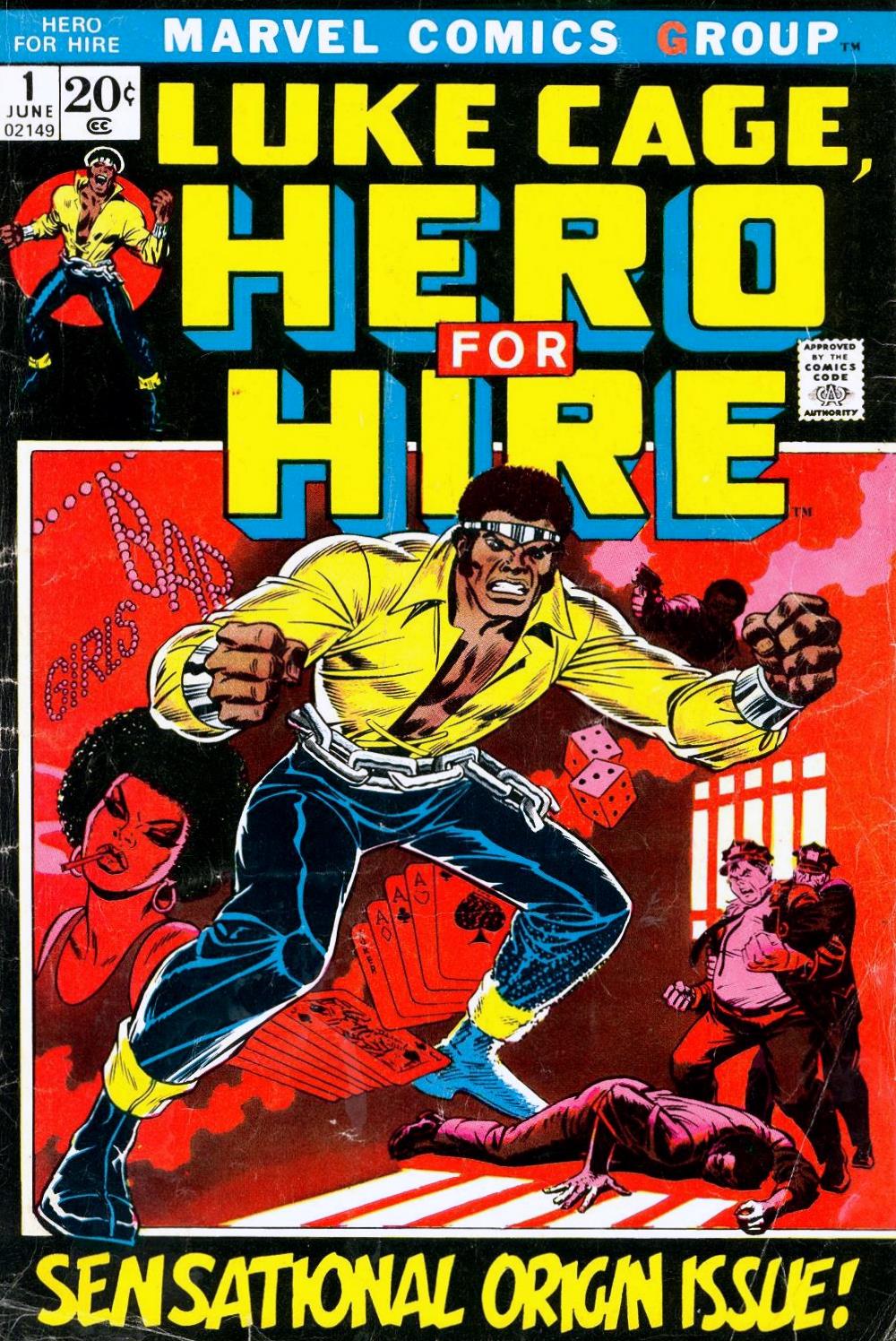
Movies like The Omen and The Exorcist prompted a greater pop culture interest in the occult and Satanism, spawning comics like Ghost Rider, Son of Satan, Tomb of Dracula and Werewolf by Night. Kung-fu flicks were the motivation behind Iron Fist and Shang Chi: Master of Kung Fu. Eventually, the wheel stopped on blaxploitation, and Luke Cage, Hero for Hire was born.


A man convicted for a crime he didn't commit, experimented on behind bars and who emerged from captivity with tremendous strength and bulletproof skin.

Despite having pretty much the same origin and power set, Netflix's Luke Cage (as played by Mike Colter) bears little visual resemblance to that character (even though the showrunners carefully work in a great reference to his original look during his origin flashback!).


In the comics, Luke Cage has gone from being the brash, confrontational fellow whose loud facade concealed a thoughtful and calculating man, to a quieter, more self-assured one who doesn't raise his voice too often because he doesn't have to. Colter's Cage is cut from the same cloth.

I mentioned how impressed I was with Mike Colter's casting in Jessica Jones, and he brings the same reflective intensity to his star turn here. Showrunner Cheo Hodari Coker and his writers have not only brought Marvel's first black superhero to the screen in a big, big way, but they have also given us the fundamentally most decent person to star in a Netflix show yet.

It's a bit of an unfair comparison: Jessica Jones didn't ask be to doubly traumatized, first by her origin and then later by her captivity under the mind control of Killgrave. The plot of Daredevil often seems to rely on Matt Murdock making bad decisions and alienating those closest to him, just like in the comics. Luke Cage is a superpowered hip-hop western, about a reluctant fighter looking for peace. Later on, when he finds himself having to fight more often, it is clear that he will not kill anyone, even though he has the means.

We meet Luke Cage working in Pop's Barbershop, sweeping hair and supplying towels, being paid under the table. Not glamorous, but he's happy to help Pop provide an oasis of sanity in Harlem, a salon and meeting place where youngbloods play videogames in the back, while men play chess and talk basketball up front. The sign on the wall says profanity is NOT allowed, and offenders pay their levies to the swear jar, a battered coffee can on the shelf.

Later on we see that this easygoing social hub is Pop's real mission: a chance for young men to see grown ups working, in uniform, taking pride in themselves.

The blackness of the show is prevalent, without being offputting. The majority of both crew and characters are people of color. Harlem, in all its glory and tragedy, emerges as a character in its own right: inspiring, revealing, and concealing in turn. Every place with a name brings a layer of meaning: Martin Luther King, Crispus Attucks, Jackie Robinson.

This undercurrent of self-improvement and empowerment is the foundation that Luke Cage is built on. Later on, a former ball player laments that he learned the game from his father, and now, no young black men want to play, because the fathers are all gone; bitter stuff.

Others are content to build their progress on the backs of others, like club owner and ganglord Cornell "Cottonmouth" Stokes and his cousin, city councilwoman Mariah Dillard.

Cottonmouth is played with suave, dangerous tension by Mahershala Ali, who can play the thug with one hand while keeping time as the sophisticated businessman with the other, and all over an underlay of regret as we learn more about his past.

Meanwhile, Mariah Dillard preaches about the Harlem renaissance and the rich, black history of the neighbourhood, pulling funds for an ambitious real estate development from her unscrupulous cousin while telling him she doesn't want to know where they came from. Alfre Woodard brings the same charm and intensity but in inverse proportions and aspect, to amazing effect.

From a comic book perspective, Luke Cage is a bit of a slow boil, with only a little action to begin with, and a main character unwilling to reveal his abilities. Eventually he gets there, but the journey here, at least in the arc that covers the first 6 episodes like a mini-season, is a lot less about defeating the villain, and coming to grips with oneself.


The opening credit sequence is Luke Cage in a microcosm: a punch that takes almost a minute to reach its target, while landmarks and street signs from Harlem illuminate the back and arms of the man punching. The funky breakbeat and guitar give way to the soaring strings from scores like Shaft and Rocky, and horns finish the build as the fist finally reaches its target and debris falls away to reveal the eponymous title. Oh, and let the record state that the moment they release a soundtrack for this show, featuring its hip-hop score and source music with a pinch of jazz, I will be getting it.

I'm 8 episodes in, believe that most high schools would benefit from showing Luke Cage every February, and cannot wait to see how it all turns out, and how it will tie into the next chapters of the Marvel Cinematic Universe on Netflix, Iron Fist and The Defenders.

Thursday, September 8, 2016

A Half-Century In The 23rd Century

We moved to Leduc in the spring of 1974, when I was most of the way through first grade. My new schoolmates were friendly, and we spent recess one day drawing on the chalkboard. One boy drew a set of parallel cylinders joined by a couple of rectangles. Speed lines came out the back, and two thin beams lanced out from the bottom of the topmost cylinder.

More details filled out the shape; windows, lights, some letters and numbers. I was intrigued, and asked, "What's that?"

"It's the starship, Enterprise," he said,"from Star Trek, on television."

After school, I rushed home so I could be in front of channel 13 at the appointed time, and I was transfixed- or maybe better to say transported.

I was immediately drawn in by the strange locales, the outlandish adventure and the bravery and gallantry of the crew of the U.S.S. Enterprise. Any chance I got to see more of Captain Kirk, Mr. Spock, and Dr. McCoy (and the rest of the crew, of course), I took it. I remember Mum laughing when I told her about this new show, and how disappointed I was when she told me it had been cancelled when I was three. It meant that there was a limit on how much of this strange new world I would be able to experience, but I was determined to eke out as much as I could.


Like many of my peers, I bought a model kit of the Enterprise and assembled it in a slapdash fashion, but was puzzled by the sheet of decals included with it. Barely familiar names like Lexington, Potemkin, Intrepid, Hood, and their associated registry numbers suggested an even larger imagined universe, with links to real military history. Years before I would read Lord of the Rings, this was my first exposure to the tantalizing allure of world-building: the creation of an imaginary place particularly suited to the telling of specific stories.

I would watch these stories on television, and devoured the James Blish novelizations from the public library. At a bookstore in Southgate mall, I spotted the Star Trek Concordance and the Star Trek Puzzle Manual, and begged Dad to get the puzzle manual for me. It turns out the Concordance would become a valuable collectible in later years, but I was enthralled with the manual, written as excerpts of various Starfleet Academy training manuals.

The ardour of my classmates cooled somewhat as I entered junior high while my passion for Star Trek remained, but it was changing. The ethics of the crew, the morality of the stories, they began to inform my own sense of right and wrong. Even when I didn't agree with how Kirk handled a situation (which was rare), I respected his courage and commitment.
Kirk: "Let me help." A hundred years or so from now, I believe, a famous novelist will write a classic using that theme. He'll recommend those three words even over "I love you." (from City On The Edge Of Forever)
(If my ethos has a cornerstone, 'Let me help' is it.)

I came to understand the Enterprise's true purpose: as a vehicle for ideas, and ideals.

I was too young or sheltered to recognize how progressive it was to have a black woman officer on a television show, but the ethnically diverse, multi-racial and multi-species bridge crew of NCC-1701 showed me a multi-coloured world that worked.

When I saw other students bullied, or was a victim myself, I knew it was a fear of the Other that provoked it. It was a fear I had as well, but maybe a little less, and perhaps a little more controllable because I knew where it came from, and how illogical it was.

In the snarky interchanges between the passionate Dr. McCoy and the stoic Mr. Spock, I saw the value of both emotion and logic, and how much more effective each is when tempered by the other.

During the long dry spell between new episodes on television and the eventual movies, I discovered role-playing and tactical games set in the Star Trek universe, and played both in high school with like-minded fellows. I learned to tell stories in an established setting. Novels began to trickle out, giving us even more insight into the idealized future of the 23rd century.

Then, the movies, followed by a return to television in The Next Generation. The Star Trek universe was not only robust enough to survive two set re-dressings and costume changes in a short space of time, but could leap ahead almost a century and populate itself with new characters, in a future where enemies had become allies. (I'm not saying that the Klingon-Federation peace had any real bearing on the dismantling of the Berlin Wall and the end of the Cold War, but...)

More shows followed, and more movies, and some were hits, and some were misses. But through them all, this optimistic and inclusive future, a future of abundance and exploration, remained.


This quirky little show with the astonishingly original looking spaceship, originally pitched as "Wagon Train in space", premiered on this night 50 years ago - September 8, 1966. Star Trek has been a cultural touchstone ever since,

Martin Luther King begged Nichelle Nichols not to leave the show, so she could be an example to other people of colour, and especially women.

James Doohan and Deforest Kelly received hundreds of pieces of fan mail from engineers and doctors who were inspired to take up these professions by their fictitious portrayals.

Cell phones, jet injectors for inoculations, modern computers, medical scanners - they can all trace their roots to a silly space opera that barely ran three seasons, but the lasting impression, the perpetual gift of Star Trek, will always be its idealism.
Capt. Kirk: They used to say if man could fly, he'd have wings, but he did fly. He discovered he had to. Do you wish that the first Apollo mission hadn't reached the moon, or that we hadn't gone on to Mars and then to the nearest star? That's like saying you wish that you still operated with scalpels and sewed your patients up with catgut like your great-great-great-great grandfather used to. I'm in command. I could order this, but I'm not because Doctor McCoy is right in pointing out the enormous danger potential in any contact with life and intelligence as fantastically advanced as this, but I must point out that the possibilities - the potential for knowledge and advancement - is equally great. Risk! Risk is our business. That's what this starship is all about. That's why we're aboard her. You may dissent without prejudice. Do I hear a negative vote? (from Return to Tomorrow)


In January, Star Trek returns to television (well, via a streaming service in the U.S., but still...), and there are numerous indications that showrunner Bryan Fuller is intent on taking the franchise back to its progressive roots. Half a century later, the rallying cry of Trekkies through the lean years, "Star Trek lives!", has never been more true.

I have every confidence that I will be referencing Trek until I am too old to remember it, and that phrases like "Live long and prosper" will continue to resonate until we reach the 23rd century. Perhaps this sentiment and the spirit that spawned it will eventually echo into a future that looks more like the utopia that is the United Federation of Planets, and not our troubled little globe.